blog / Apple Changed the Rules on October 1. Where Should Your App Take Payments Now?


A practical guide for subscription, marketplace and content apps. Updated October 2026.
For fifteen years, the answer to "how should our iPhone app take payments?" was short: Apple’s in-app purchase, and Apple takes its cut.
That answer is now a choice. On October 1, 2026, Apple’s new business terms for the EU took effect. In the US, a long court fight with Epic Games has already opened the door to linking users to web checkout, and that fight is still going.
The result: payment setup is no longer a technical detail. It is a product and revenue decision, and it belongs in your 2027 app budget. Below, we explain what changed and walk through three typical apps to show how the choice plays out.
What are Apple’s new App Store fees in the EU?
From October 1, 2026, EU developers work under one set of Apple terms with four main payment paths, each with its own commission. Apple replaced the old per-install Core Technology Fee with a transaction-based Core Technology Commission and removed the Initial Acquisition Fee and the Store Services Fee.
According to Apple’s announcement (also covered by Mobile Marketing Reads), the standard rates are:
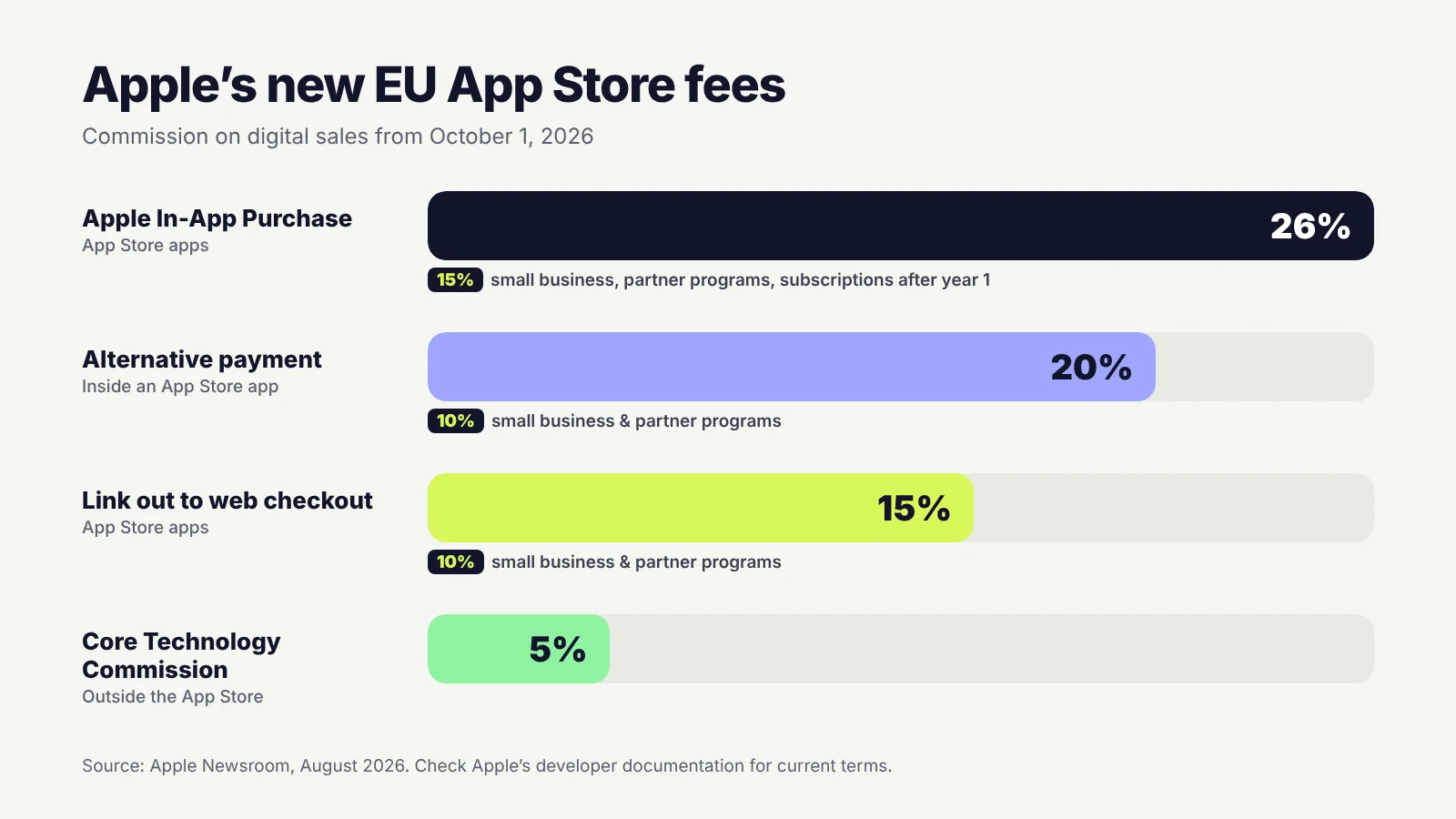
26% for Apple in-app purchase in App Store apps
20% for an alternative payment provider inside an App Store app
15% for linking out to a web checkout
5% Core Technology Commission for apps distributed outside the App Store, through alternative marketplaces or the web
Lower rates apply too: in-app purchase drops to 15% for developers in the Small Business Program and some partner programs, and for auto-renewing subscriptions after their first year. Alternative payments and link-outs drop to 10% for those programs. Developers can combine Apple in-app purchase with other options, but once chosen, a setup must stay in place for 12 months. Always confirm the current details in Apple’s developer documentation before you decide.
What is the Core Technology Commission?
The Core Technology Commission is Apple’s 5% charge on sales of digital goods and services in apps distributed outside the App Store in the EU. It replaced the Core Technology Fee, which charged per install and scared away many developers because a viral free app could owe Apple money without earning any.
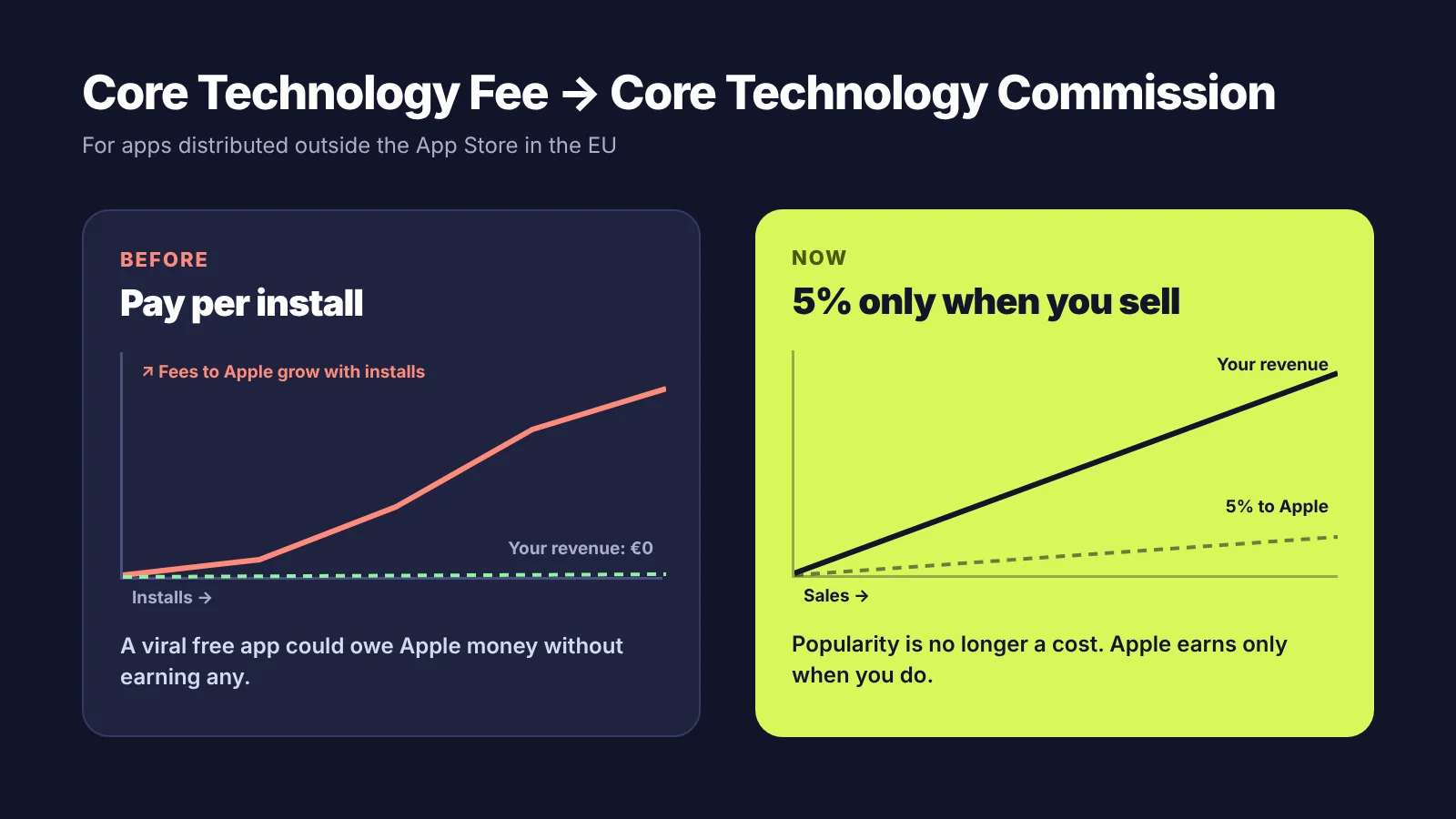
The change matters most for free apps with large audiences, from mobile games to utilities. Under the old model, popularity itself was a cost. Under the new one, Apple only earns when you do.
In-app purchase vs web payments: what changed in the US?
In the US, apps can show links to web checkout, but how much Apple may charge on those purchases is still being decided in court. In 2025, a federal judge barred Apple from charging commission on external link purchases. Since then, the case has gone through appeals, and the Supreme Court has been asked to review it.
For product teams, the practical lesson is simple: build your payment setup so you can switch paths without rebuilding the app. Rules are moving in more than one market at once, and a messy release can cost you more than the commission. Our tips for smoother software launches apply here too.
Three apps, three decisions: choosing your payment strategy
Every app is different, so instead of a formula, here are three typical cases. They are composites, not real clients, but we see these patterns constantly.
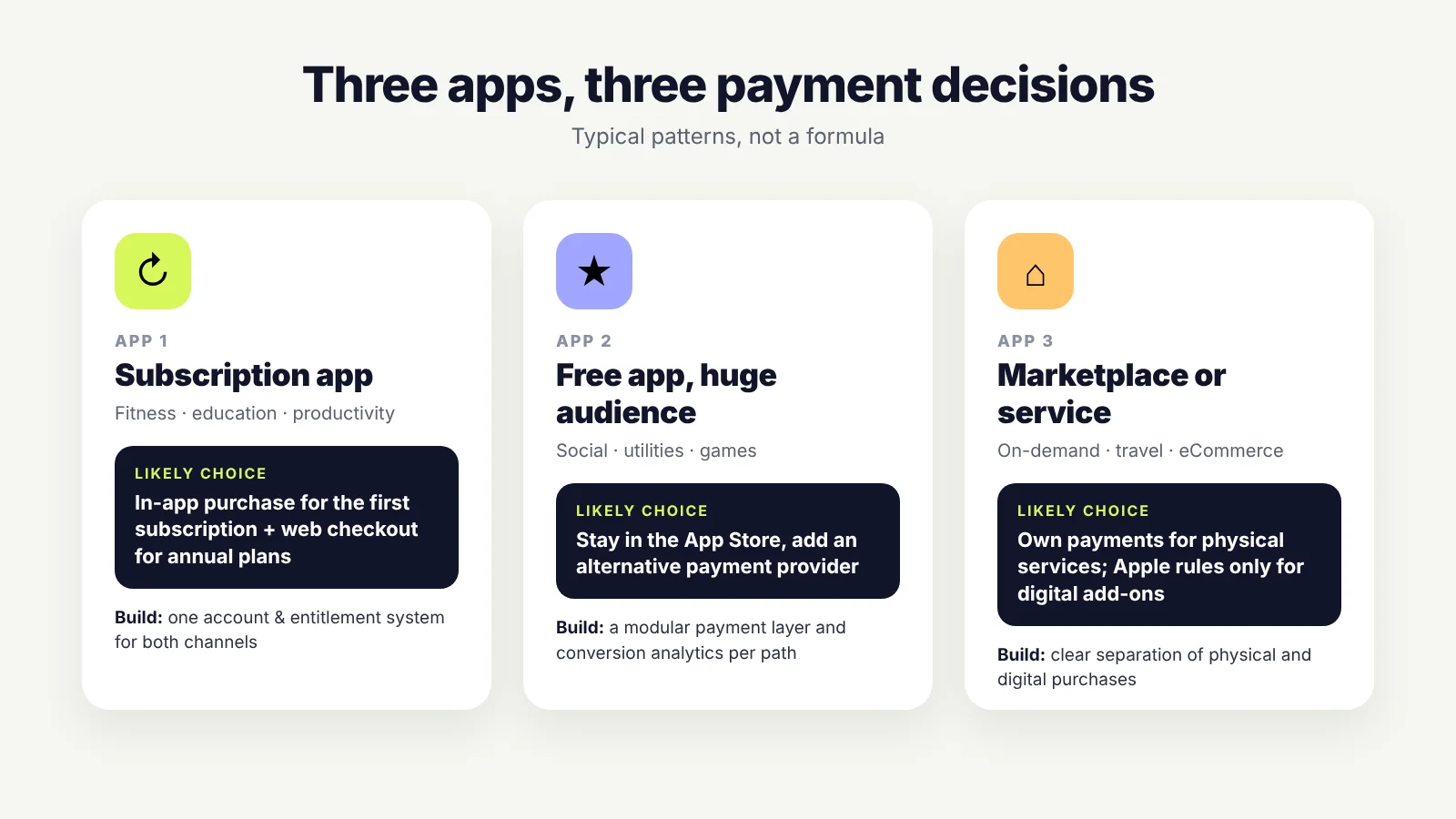
App 1: The subscription app (fitness, education, productivity)
A language learning app charges a monthly subscription. Most revenue comes from users who have stayed for more than a year.
The likely choice: keep Apple in-app purchase for the first subscription, because it converts best, and add a web checkout link for annual plans and renewals. Auto-renewing subscriptions already drop to a lower rate after the first year in Apple’s system, so the math changes over a user’s lifetime, not just at signup.
What to build: a shared account system so a user who pays on the web gets access in the app instantly, plus clean subscription status handling across both channels. We cover engagement for these products in How to Build a Fitness App That Keeps Users Hooked and How to Develop an Educational App. Retention is what makes the year-two discount pay off, so see also how UI/UX drives retention.
App 2: The free app with a huge audience (social, utilities, games)
A free photo app has millions of installs and earns through optional upgrades.
The likely choice: this is the app the old per-install fee hurt the most. Now, distributing outside the App Store in the EU means paying only on actual sales. Still, most users discover apps in the App Store, so leaving it is rarely worth it (although app discovery is shifting to AI assistants). More often, the right move is an alternative payment provider inside the App Store app.
What to build: a payment layer that can plug in a second provider without touching the rest of the app, and analytics that show conversion per payment path.
App 3: The marketplace or service app (on-demand, travel, eCommerce)
A booking app sells physical services: rides, rooms, repairs.
The likely choice: nothing changes for the main transaction. Apple’s commissions apply to digital goods and services; physical goods and real-world services have long been allowed to use their own payment providers. What does change is anything digital on top: premium memberships, priority access or paid features.
What to build: a clear separation between physical transactions and digital add-ons, so each follows the right rules. See how we approach these products in On-Demand App Development Made Easy, building a food delivery app, the future of travel apps and high-converting eCommerce apps.
Not sure which of the three your app is? Send us a short description of how you charge today, and we will tell you which payment paths are worth testing under the new rules. Get a payment setup review →
How to add web checkout to an iOS app without hurting conversion
Web checkout saves commission only if users actually finish paying. Every extra step, from leaving the app to typing card details, loses some of them.

What protects conversion:
Fast, familiar payment on the web page: Apple Pay, Google Pay and saved cards, not a long form.
A seamless return to the app with access already unlocked, through universal links and server-side entitlements.
Honest messaging. Tell users why the web option exists, for example a better price, and let them choose.
Testing. Run both paths side by side and compare real revenue per user, not just commission saved.
Security. A new payment path is a new attack surface. Read why one breach can end a startup.
Looking further ahead, AI agents will start paying on behalf of users, too. We cover that shift in Agentic Checkout Is Here and how to prepare your product in the Agent-Ready Scorecard.
Subscription app monetization in 2027: a short checklist
Map which of your products are digital and which are physical
Decide which payment paths you will use per market (EU, US, rest of the world)
Build one account and entitlement system that works for every path
Make the payment layer modular, so rules can change without a rebuild
Track revenue per user per payment path, not only conversion
Re-read Apple’s and Google’s guidelines before every major release
Skipping these steps is one of the quiet reasons apps stall after launch. More in The App Graveyard: Why Apps Die in Their First 90 Days.
How Olearis helps apps get their payment setup right

Olearis builds iOS, Android, Flutter and web products with payments at their core, from banking apps and financial apps to subscriptions, marketplaces and eCommerce. When rules change, we help clients decide what to switch, what to keep and how to ship it without breaking checkout.
Not sure which payment path fits your app? Tell us how you charge today. In one 30-minute call, we will map your options under the new rules and what it would take to support them. Tell us about your project →
FAQ: App Store fees and web checkout
What are Apple’s App Store fees in the EU from October 2026?
Under Apple’s new EU terms, standard rates are 26% for Apple in-app purchase, 20% for alternative in-app payments, 15% for web link-outs and a 5% Core Technology Commission for apps distributed outside the App Store. Lower rates apply to small businesses, some partner programs and subscriptions after their first year.
Can my iOS app link to a web checkout?
In the EU, yes, under Apple’s link-out terms. In the US, links to web checkout are allowed following the Epic Games case, while the question of what Apple may charge is still in court. Check current rules before launch.
Does Apple take a commission on physical goods or services?
No. Apple’s in-app purchase rules cover digital goods and services. Physical products and real-world services, like rides, deliveries or hotel stays, can use their own payment providers.
Is web checkout always cheaper than in-app purchase?
Not always. Lower commission helps only if conversion stays high. Payment provider fees and lost users at checkout can eat the difference, so test both paths with real users.
Do these changes affect Android apps?
These rules are Apple’s. Google Play has its own billing and fee policies, which are also changing in several markets, so Android payments need a separate review.