blog / Nobody Searched the App Store Today: How People Will Find Your App in 2027


A story in five scenes, and what each one means for your product. Updated October 2026.
Meet Maya. She is 34, runs a small design studio and has a phone full of apps. Today she will find, try and pay for two new ones.
She will not open the App Store once.
This is not science fiction. Every scene below is possible with tools that already exist. What is changing is habit: people are moving from searching to asking. And when people ask, an AI decides what to show them.
If you build or market an app, that AI is now your most important gatekeeper. Let’s follow Maya’s day and see where your app wins, or quietly loses.
How will users discover apps in 2027?
In 2027, most app discovery starts in a conversation, not a store search. Users ask ChatGPT, Gemini, Claude or Siri for help with a task, and the assistant recommends, opens or directly uses an app. The App Store still matters for the download, but the decision is often made before the user gets there.
That shift has a name: GEO, or generative engine optimization. If ASO (app store optimization) was about ranking in store search, GEO for apps is about being the app an AI assistant chooses to mention.
8:10 a.m. — How ChatGPT recommends apps (and how to get yours recommended)

Maya has coffee and types into ChatGPT: "I keep forgetting to invoice clients. What’s a simple app for freelancers that sends reminders?"
The assistant answers with three options and a short reason for each. One of them already works inside ChatGPT, so Maya connects it in two taps and sends her first invoice without leaving the chat.
The lesson: the AI did not pick apps by keyword density. It picked apps it could explain: ones with a clear purpose, described the same way across the web, and, in one case, an app it could actually use.
What helps an app get recommended by ChatGPT and other assistants:
One sentence that says what you do and for whom. Repeat it on your site, store page, LinkedIn and press mentions. Consistency is how a model learns who you are.
Answer the questions users actually ask on your website, in plain language, in a FAQ. Assistants quote pages that answer directly.
Be usable, not just findable. Apps that run inside ChatGPT or connect through MCP skip the "go download it" step. We explain how in our Agent-Ready Scorecard.
12:30 p.m. — Siri, Apple Intelligence and app discovery without the App Store

At lunch, Maya asks Siri to "add today’s receipt to my expenses." She already has the invoicing app from the morning. Siri finds the right action inside it, scans the receipt and files it.
Maya never opened the app. But she used it, and she will keep paying for it.
The lesson: on iOS, App Intents let Siri, Spotlight and Apple Intelligence trigger your app’s actions directly. On Android, App Actions do the same for Gemini. Every action you expose is a new entry point that does not depend on the home screen.
This is the quietest shift on our list and maybe the most important. Apps that the operating system can "see inside" get used more. Apps that are a closed box only get used when someone remembers to tap the icon. More on what iOS 27 gives developers in Apple Just Handed Your App Free AI.
3:00 p.m. — AI search and AI Overviews: why your app’s website matters again
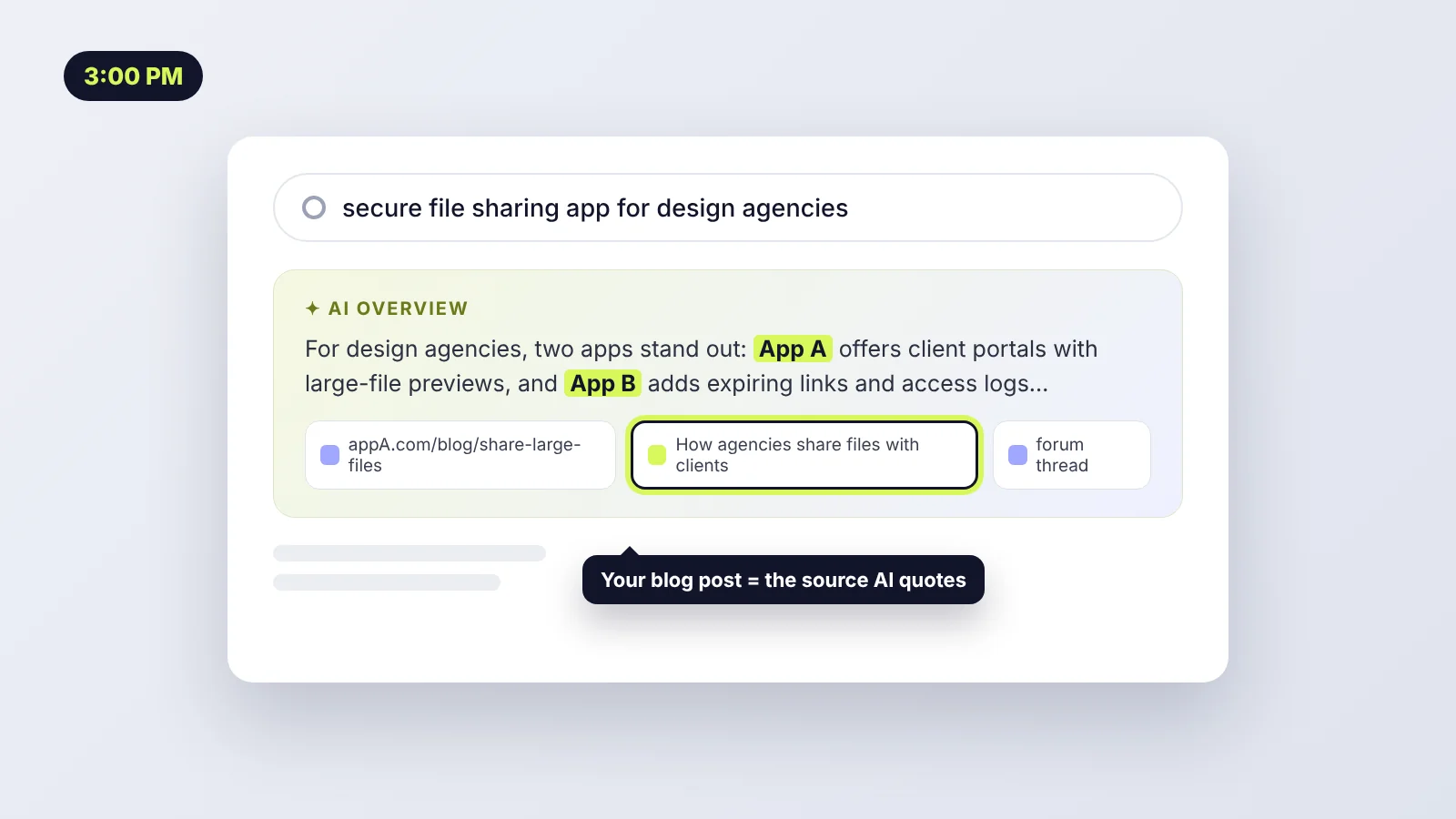
A client asks Maya to share files securely. She googles "secure file sharing app for design agencies." The top of the page is an AI-written summary that names two apps and links to the sources it used.
She clicks one of those sources. It is a blog post from the app maker, explaining exactly her situation.
The lesson: for years, many app companies treated their website as a landing page with two store badges. In AI search, that is a mistake. AI Overviews and answer engines like Perplexity build answers from web pages, not from store listings. If your site has nothing to quote, your competitor’s blog gets quoted instead.
What to do:
Write pages for problems, not for features. "How design agencies share large files with clients" beats "Our features."
Use headings that match real questions, and answer each in the first two sentences.
Keep it current. AI search prefers fresh, dated content, which is one reason this article says "Updated October 2026" at the top.
Curious what AI says about your app right now? Send us your app name. We will ask ChatGPT, Gemini and Perplexity the questions your users ask and show you who gets recommended instead of you. Get your app discovery check →
7:00 p.m. — Reviews, Reddit and communities: the sources AI models trust
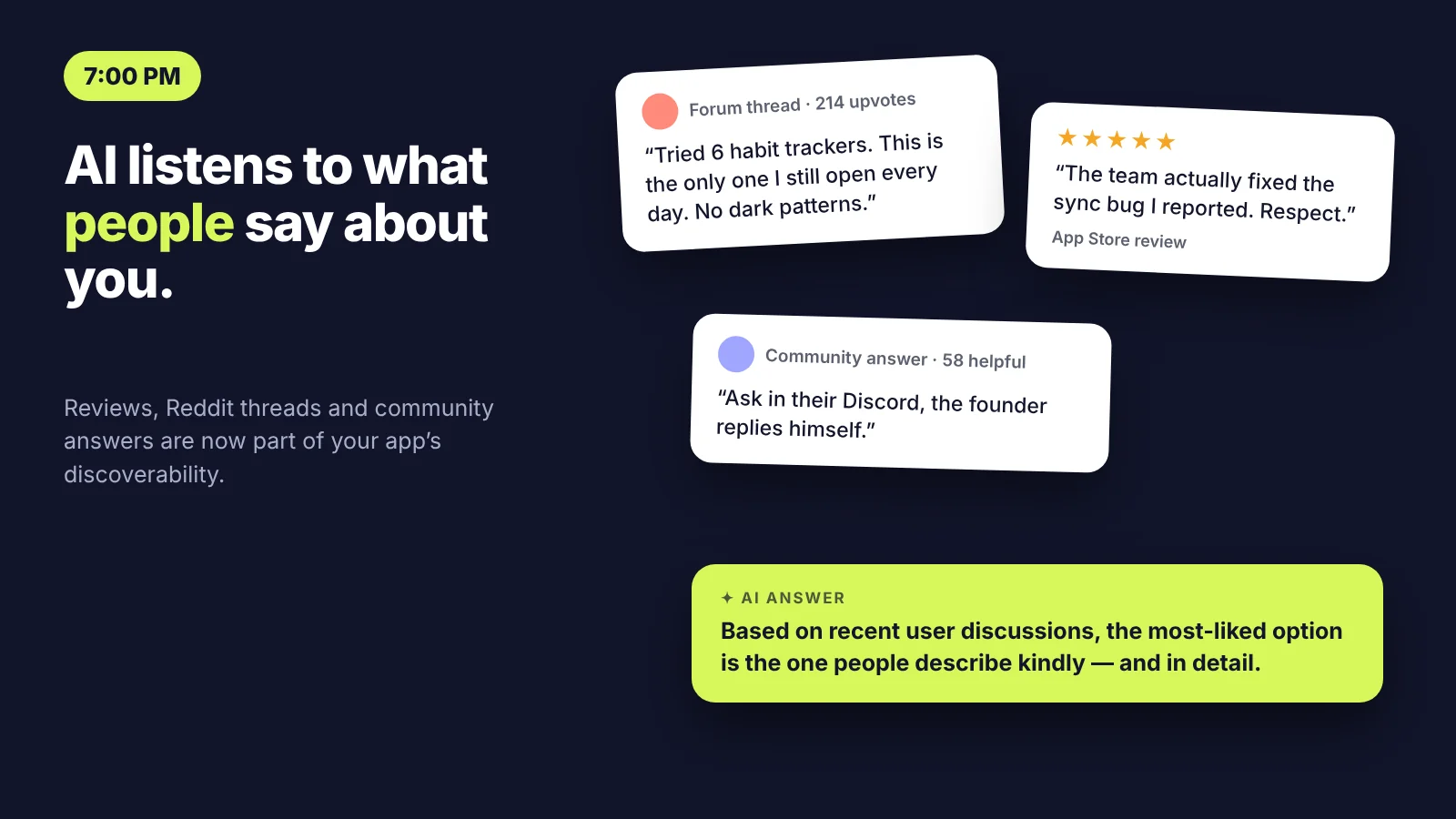
In the evening, Maya wants a habit tracker. This time she asks Perplexity, and adds: "one that real people actually like, not ads."
The answer leans on Reddit threads, a few independent reviews and App Store ratings. The app it recommends is not the biggest one. It is the one people talk about kindly, and in detail.
The lesson: AI models weigh what other people say about you, not just what you say about yourself. Reviews, forum discussions, comparison articles and community answers are part of your app’s discoverability now.
That does not mean faking reviews. It means:
Ask happy users for reviews at the right moment, right after a success, not on first launch.
Show up where your users ask questions: answer honestly on Reddit, Quora or niche communities, as a real person from your team.
Fix what reviews complain about, then say so publicly. "We heard you" posts get quoted.
10:00 p.m. — Retention is the new app discovery signal

Before bed, Maya realizes she has not opened one of the apps she downloaded last month. She deletes it. Tomorrow, when someone asks an assistant about apps like it, there will be one less happy user out there talking about it.
The lesson: discovery and retention are now the same loop. Apps that keep users get reviews, mentions and recommendations. Apps that lose users quietly disappear from the conversation, both human and AI. We wrote about why so many apps fade early in The App Graveyard: Why Apps Die in Their First 90 Days, and how design drives it in How Mobile UI/UX Design Impacts User Retention.
ASO vs GEO: how AI app marketing changes in 2027
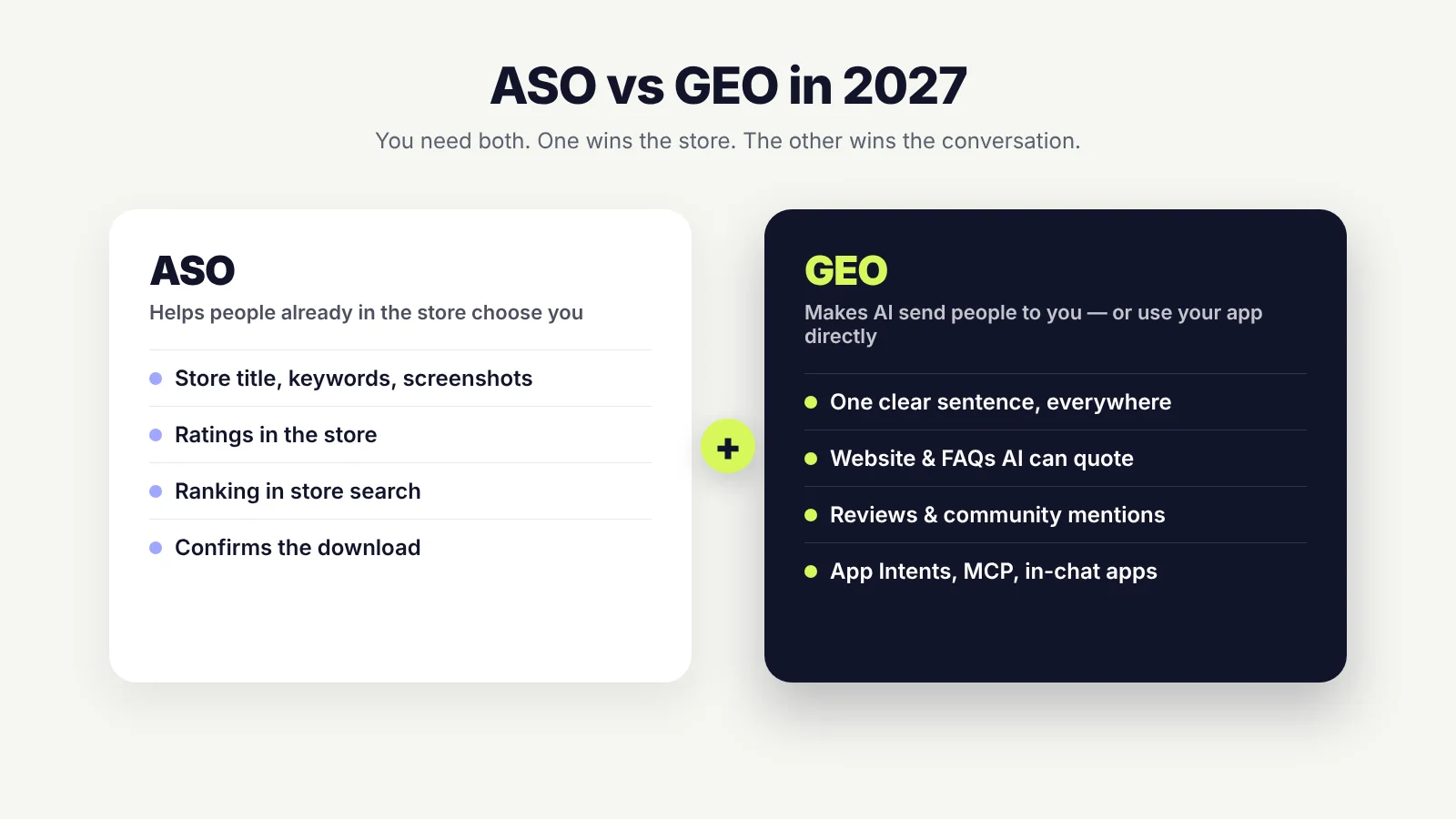
ASO is not dead. It just stopped being the whole game. App store optimization in 2027 still matters, because the store page is where the download happens. But the decision to download is increasingly made earlier, in a chat, a voice command or an AI summary.
Think of it this way. ASO helps people who are already in the store choose you. GEO helps the AI send people to the store with your name already in their head, or skip the store entirely because the assistant can use your app directly.
The teams that win in 2027 do both. They treat their store page, website, help center, reviews and in-app actions as one connected story that both humans and AI can read.
App discovery checklist for 2027
One clear sentence about what your app does and for whom, repeated everywhere
A website with problem-focused articles and FAQs, not just store badges
Headings that match real user questions, answered in the first lines
Key actions exposed through App Intents (iOS) and App Actions (Android)
An MCP server or ChatGPT app for your core actions, if your product fits a chat
A review strategy that asks happy users at the right moment
Someone from your team active in the communities your users trust
Retention work prioritized as much as acquisition
Ticked fewer than five? That is exactly the gap your competitors can use.
How Olearis builds apps people (and AI) can find
At Olearis, we design and build iOS, Android, Flutter and web products for startups and enterprises. Discovery is part of the build, not an afterthought: we plan App Intents, agent access, analytics and retention mechanics from the first sprint, because those decide whether an app gets found and kept.
Want to know how your app looks to an AI assistant? Tell us about your product. In one 30-minute call, we will walk through how Maya would find you, or why she wouldn’t, and what to change first. Tell us about your project →
FAQ: App discovery, ASO and GEO
What is GEO for apps?
GEO, or generative engine optimization, is the practice of making your app easy for AI assistants like ChatGPT, Gemini, Claude and Siri to understand, recommend and use. It covers your website content, reviews, consistent messaging and in-app actions exposed to AI.
How do I get ChatGPT to recommend my app?
Describe your app the same clear way everywhere, publish helpful content that answers your users’ questions, earn genuine reviews and community mentions, and consider making your core actions usable inside ChatGPT through its apps platform or MCP.
Is app store optimization still worth it in 2027?
Yes. The store page is still where the download decision is confirmed. But ASO alone is no longer enough, because many users decide what to download before they reach the store.
Do App Intents help app discovery?
Yes. App Intents let Siri, Spotlight and Apple Intelligence surface and run your app’s actions, which creates new entry points and keeps users engaged without opening the app manually.
Does a mobile app need a blog?
If you want to appear in AI search, yes. AI answers are built from web pages. A blog or help center that explains real user problems gives assistants something to quote and link to.