blog / The 2027 App Budget Memo: Copy It, Fill It, Get It Approved


For founders, product leads and CTOs heading into budget season. Updated October 2026.
It is October. Somewhere in your company, a spreadsheet called "2027 Budget v4 FINAL" is open. And there is one row that nobody wants to fill: the app.
Maybe it is a new product. Maybe it is the AI features your board keeps asking about. Maybe it is the app you already have, which costs more every quarter and nobody can explain why.
This article is not another "how much does an app cost" list. It is a memo. You can copy it, fill in the brackets and send it to whoever signs the budget. We wrote it after years of watching good projects get cut, not because the idea was bad, but because the budget request was vague.
Why is 2027 budget planning different?
Because the money is there, but it is going to AI first, and finance wants proof. Gartner expects worldwide IT spending to reach $6.31 trillion in 2026, up 13.5%. Software alone grows 15.1% to $1.44 trillion, and spending on GenAI software development is set to more than double year over year.
Translation: your CFO is not asking "should we spend on technology?" They are asking "why this project, and how do we know it will pay back?" A memo that answers that wins. A memo that lists features loses.
The memo (copy from here)
To: [CFO / CEO / Board]
From: [Your name, role]
Re: 2027 investment in [product name]1. The decision. We request [$X] for [new app / AI features / modernization] in 2027, released in [2–3] stages, with a go/no-go review after stage 1.
2. The problem it solves. Today, [specific problem] costs us [hours / churn % / lost deals / support tickets] per [month]. Source: [our data].
3. The bet. If we ship [the 1–2 core features], we expect [one metric] to move from [A] to [B] within [N] months of launch.
4. The split. 60% build, 25% launch and growth, 15% maintenance and AI running costs. (Details below.)
5. The exit. If the metric has not moved by [review date], we stop, keep what works and redirect the remaining budget.
6. The partner. [In-house / agency / hybrid], because [speed / skills / cost].
Five points, one page. That is all finance needs to say yes. Now, how to fill it in honestly.
How should you split an app budget? The 60/25/15 rule
Put about 60% into building, 25% into launch and growth, and 15% into running costs for the first year. Most failed budgets put 100% into building and nothing after launch, which is how apps end up in the 90-day graveyard.
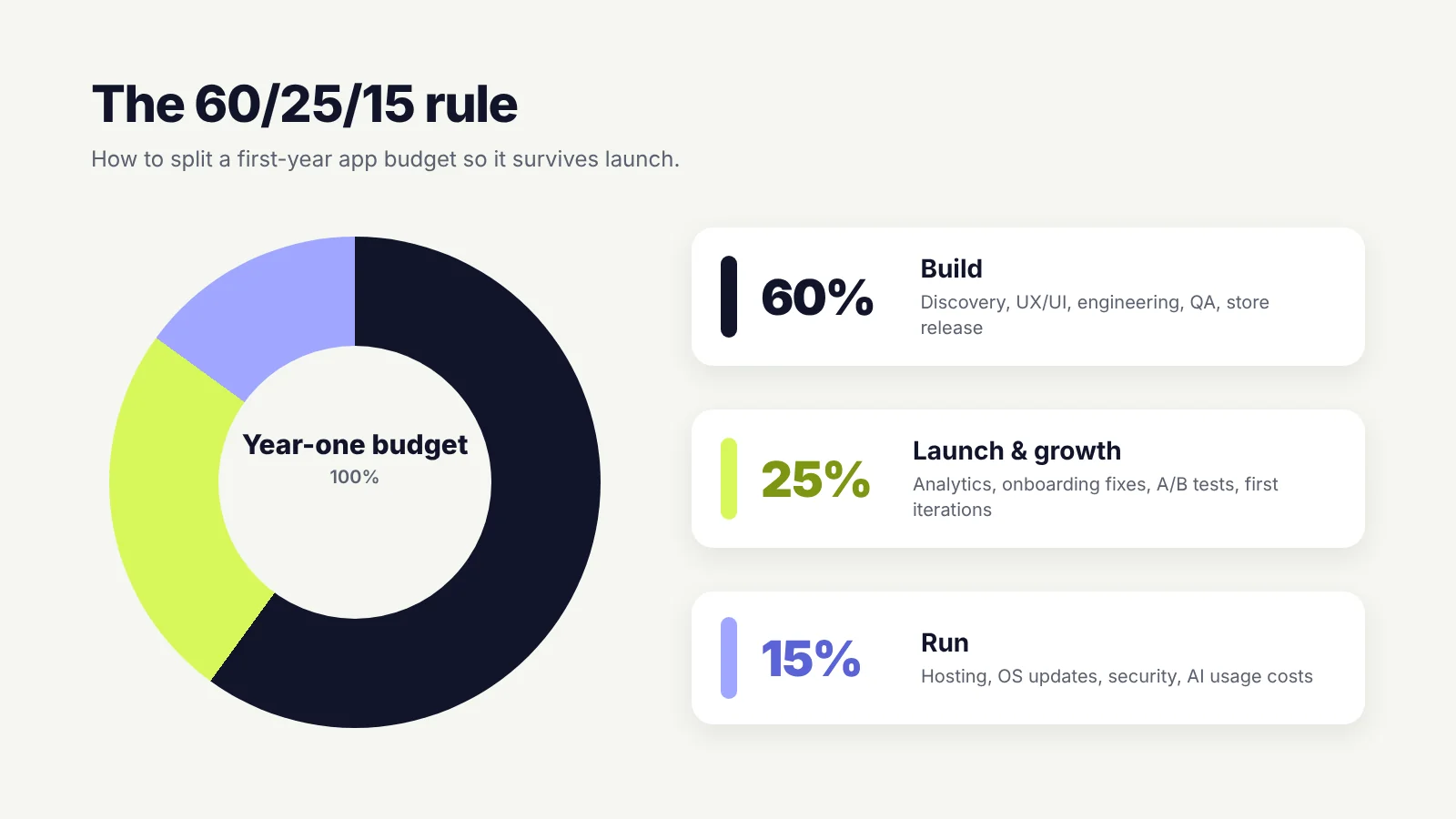
Bucket | Share | What it pays for | What teams forget |
|---|---|---|---|
Build | ~60% | Discovery, UX/UI, engineering, QA, store release | Discovery. Skipping 2–4 weeks of research is the most expensive saving you can make |
Launch and growth | ~25% | Analytics, onboarding fixes, A/B tests, first 2–3 iterations after real users arrive | Post-launch iterations. Version 1.0 is a hypothesis, not a finished product |
Run | ~15% | Hosting, monitoring, OS updates, security patches, AI usage costs | AI tokens and inference. They grow with every active user |
Is the split exact? No. A regulated health app spends more on build and compliance. A consumer app spends more on growth. But if your plan has no line for launch and run, finance will find that gap before you do.
What hidden costs should a 2027 app budget include?
These are the five line items we see missing most often:
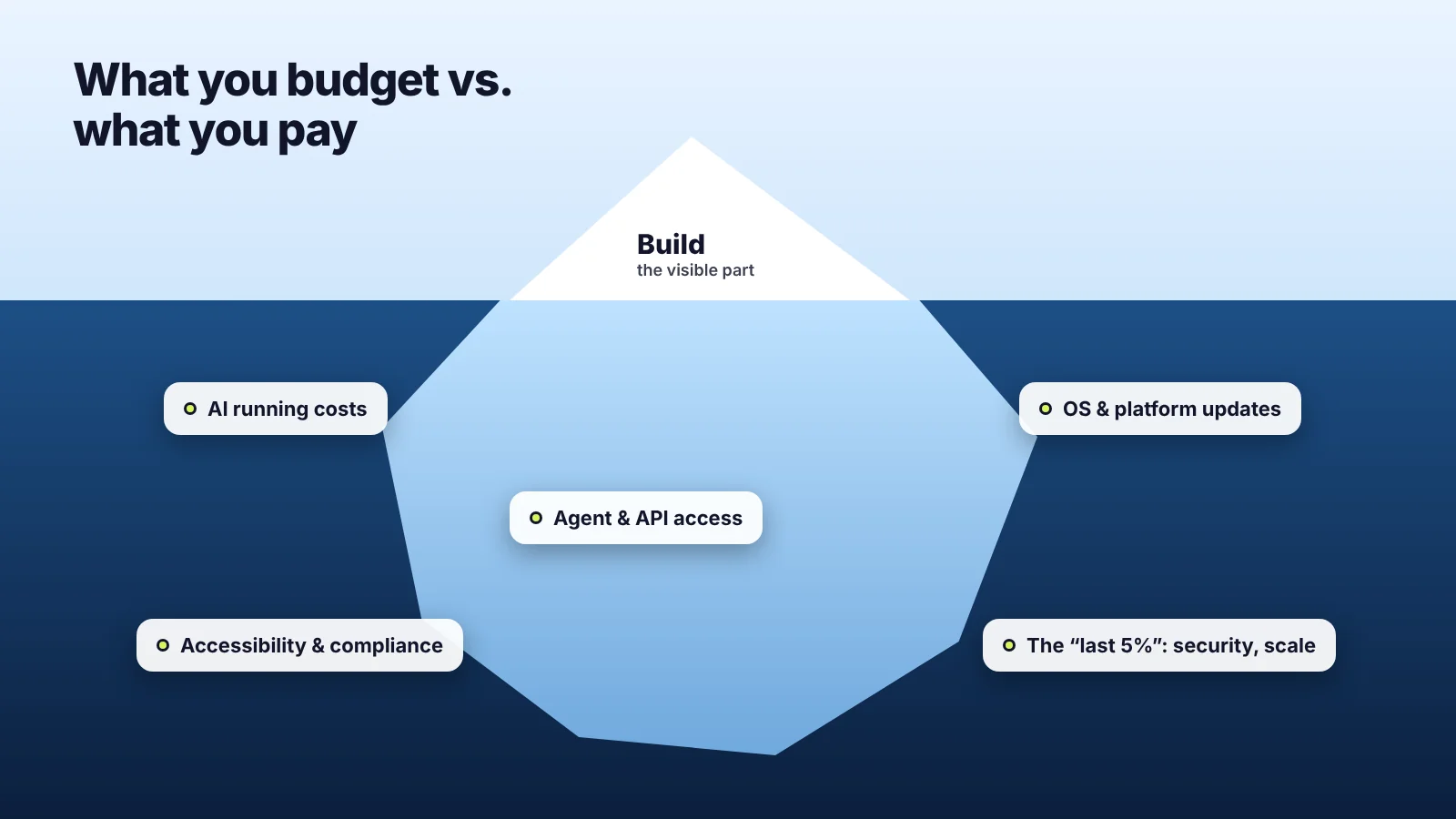
AI running costs. Every chat message, summary or recommendation costs money per request. Model it per active user per month, not as a one-time fee. We broke down the real numbers in What It Actually Costs to Build an AI App.
Platform changes. iOS and Android ship major versions every year. In 2026 alone, teams had to react to iOS 27 on-device AI and the iPhone Fold.
Agent and API access. In 2027, buyers will expect your product to work with ChatGPT, Claude and Siri. See our Agent-Ready Scorecard to estimate the gap.
Accessibility and compliance. Accessibility rules, privacy laws and AI regulation keep tightening. Building it in costs a fraction of retrofitting it. More in AI for Everyone.
The "last 5%." Prototypes built fast with AI tools look 95% done. The remaining 5% (security, edge cases, scale) is often half the work. We wrote about it in My App Is 95% Done.
How do you justify an AI feature to a CFO?
Tie it to one number the business already tracks, and promise a stop point. "AI-powered assistant" is not a business case. "Cut support tickets by 30% within six months of launch, or we switch it off" is.
Use this test for every AI line in the budget:
Which metric moves? Hours saved, tickets closed, conversion, retention. Pick one.
What does it cost to run at 10x users? If the answer scares you, redesign before you build.
What is the non-AI baseline? Sometimes a better form beats a chatbot. Our guide on why AI projects fail covers this pattern.
In-house, agency or hybrid: which is cheaper in 2027?
For a first version, a product agency is usually faster and cheaper than hiring; for a product past product-market fit, a hybrid team wins. Hiring a senior mobile, backend, design and QA team takes months before the first line of code. An agency brings a working team on day one.
Model | Best for | Watch out for |
|---|---|---|
In-house | Core product after product-market fit | Hiring time, cost of a full team for a part-time need |
Agency | MVP, new product line, AI features, fixed deadline | Knowledge transfer; ask for documentation and code ownership upfront |
Hybrid | Scaling teams that need extra skills (AI, iOS, IoT) | Clear ownership; one person must own the roadmap |
Your budget checklist before you hit send
One problem, one metric, one number
Budget split into build, launch and run
AI costs modeled per active user
A go/no-go review date after stage 1
A line for platform updates and security
A decision on in-house, agency or hybrid
Get a second pair of eyes on your 2027 plan
Olearis has helped startups and enterprises plan, build and launch products in health, fintech, eCommerce, IoT and AI. If you are drafting your 2027 budget now, send us your memo or your rough idea. In one 30-minute call, our team will sanity-check the scope, flag the hidden costs and give you a realistic estimate you can put in the spreadsheet.
Tell us about your project → · or book a call with our founder
FAQ: App development budget 2027
How much should I budget for an app in 2027?
It depends on scope, platforms and AI features, but the structure matters more than the total: about 60% build, 25% launch and growth, 15% running costs in year one. A focused MVP with 1–2 core features costs far less than a full product.
How much does app maintenance cost per year?
A common industry rule of thumb is 15–20% of the initial build cost per year, covering OS updates, security, hosting and bug fixes. AI features add usage costs on top.
What is the biggest mistake in app budgeting?
Spending the whole budget on version 1.0. Real users always reveal changes, and without a launch-and-growth budget, there is no money to make them.
Should AI features be a separate budget line?
Yes. AI has a build cost and an ongoing cost per request. Keeping it separate makes ROI visible and easy to stop if it does not pay back.
When should I start planning a 2027 app budget?
Now. Most companies finalize next-year budgets between August and November. A clear memo in October beats a perfect one in January.