blog / Your Next User Is an AI Agent. Is Your App Ready?


A 5-minute scorecard for founders and product owners. Updated October 2026.
Someone opens ChatGPT and types: "Book me a table for four on Friday, somewhere quiet." Or asks Siri to reorder last week’s groceries. Or tells Claude to pull this month’s invoices into a spreadsheet.
In each case, a person never opens an app. An AI agent does the work. The question for your business is simple: when the agent goes looking for a service to call, does it find yours?
This is not a 2030 problem. Gartner predicted that 40% of enterprise apps will include task-specific AI agents by the end of 2026, up from less than 5% in 2025. The Model Context Protocol (MCP), the open standard that lets agents talk to apps, passed 97 million monthly SDK downloads and 10,000+ public servers in about a year. ChatGPT, Claude, Gemini, Copilot and VS Code all support it.
Read that again. The plumbing for agents is already built. Most apps just are not connected to it.
Below is the scorecard we use with clients. Score yourself honestly. It takes five minutes.
What is an agent-ready app?
An agent-ready app is a product that an AI agent can discover, understand and safely act on without a human tapping through the UI. It exposes its key actions (search, book, buy, update) through structured interfaces like an API, an MCP server or OS-level intents, and it has permissions and guardrails built for a non-human caller.
Think of it as the 2026 version of "mobile-friendly." In 2012, sites that ignored phones lost traffic to sites that didn’t. In 2026, apps that ignore agents lose transactions to apps that don’t.
Why does agent-readiness matter for revenue?
Agents choose a service the way a busy assistant would: the one that works on the first try. If your competitor’s booking flow can be called by ChatGPT and yours cannot, the agent books your competitor. The user never sees your brand.
Three shifts make this urgent:
Discovery is moving into chat. Users ask assistants, not app stores. Apps inside ChatGPT, Claude connectors and Siri actions are the new shelf space.
The OS is becoming an agent. Apple Intelligence uses App Intents to act inside apps. We covered what iOS 27 gives developers here.
B2B buyers expect it. Enterprise teams now ask vendors, "Do you have an MCP server?" the way they once asked, "Do you have an API?" A Stacklok survey found 41% of software organizations already run MCP servers in production.
The Agent-Ready Scorecard: 10 checks
Give yourself 2 points for "yes," 1 for "partly" and 0 for "no."
# | Check | What “yes” looks like |
|---|---|---|
1 | Core actions have an API | Every action a user takes in the UI (search, book, pay, cancel) has a documented endpoint |
2 | The API is clean enough for a machine | Clear names, typed inputs, useful error messages; no hidden UI-only logic |
3 | You expose an MCP server | Agents in ChatGPT, Claude or Copilot can list and call your tools |
4 | Mobile actions are exposed to the OS | App Intents on iOS, App Actions on Android, so Siri and Gemini can trigger them |
5 | Agent-safe authentication | OAuth with scoped tokens; an agent can act for a user without seeing the password |
6 | Permissions and limits for agents | Spending caps, confirmation steps for risky actions, rate limits |
7 | Machine-readable product data | Prices, availability and catalog in structured form (schema.org, feeds), not only in images and PDFs |
8 | Agent traffic is visible | Analytics can tell human sessions from agent calls |
9 | Audit trail | Every agent action is logged: who, on whose behalf, what changed |
10 | Someone owns it | A named person owns the agent channel the way someone owns SEO or the App Store page |
What does your score mean?
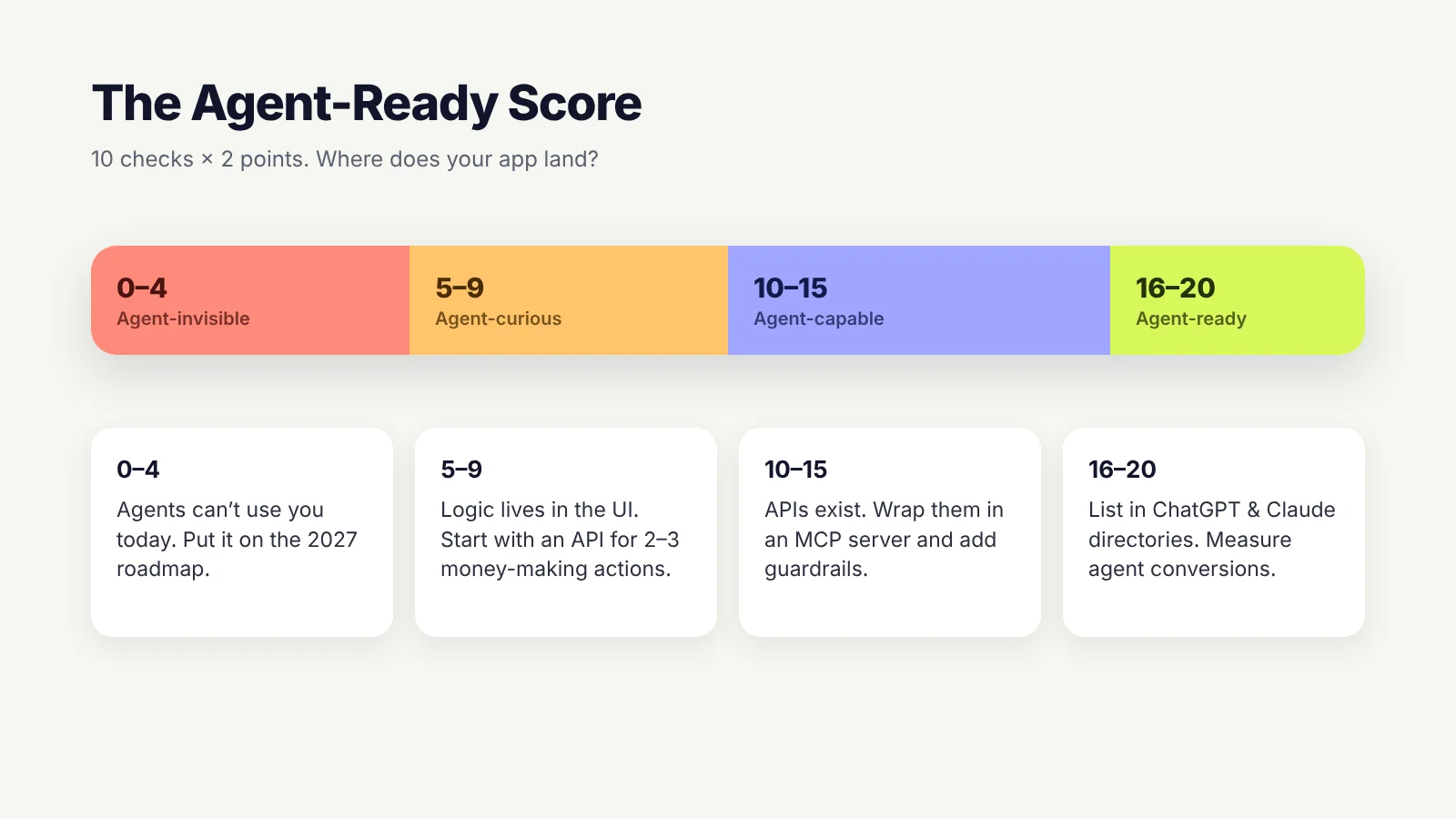
Score | Verdict | What to do next |
|---|---|---|
16–20 | Agent-ready | Launch in ChatGPT/Claude app directories and measure agent conversions |
10–15 | Agent-capable | You have the APIs. Wrap them in an MCP server and add guardrails. Usually weeks, not months |
5–9 | Agent-curious | Your logic lives in the UI. Start with an API layer for 2–3 money-making actions |
0–4 | Agent-invisible | Agents cannot use you today. Plan this into your 2027 roadmap now, before competitors do |
Landed in the 5–9 range? You are in good company, and it is not a failure. It usually means the product was built before agents existed, and the business logic sits inside screens instead of services.
How do you make an existing app agent-ready?
You do not rebuild the app. You add an agent layer on top of what works. In most projects that means four steps, in this order:
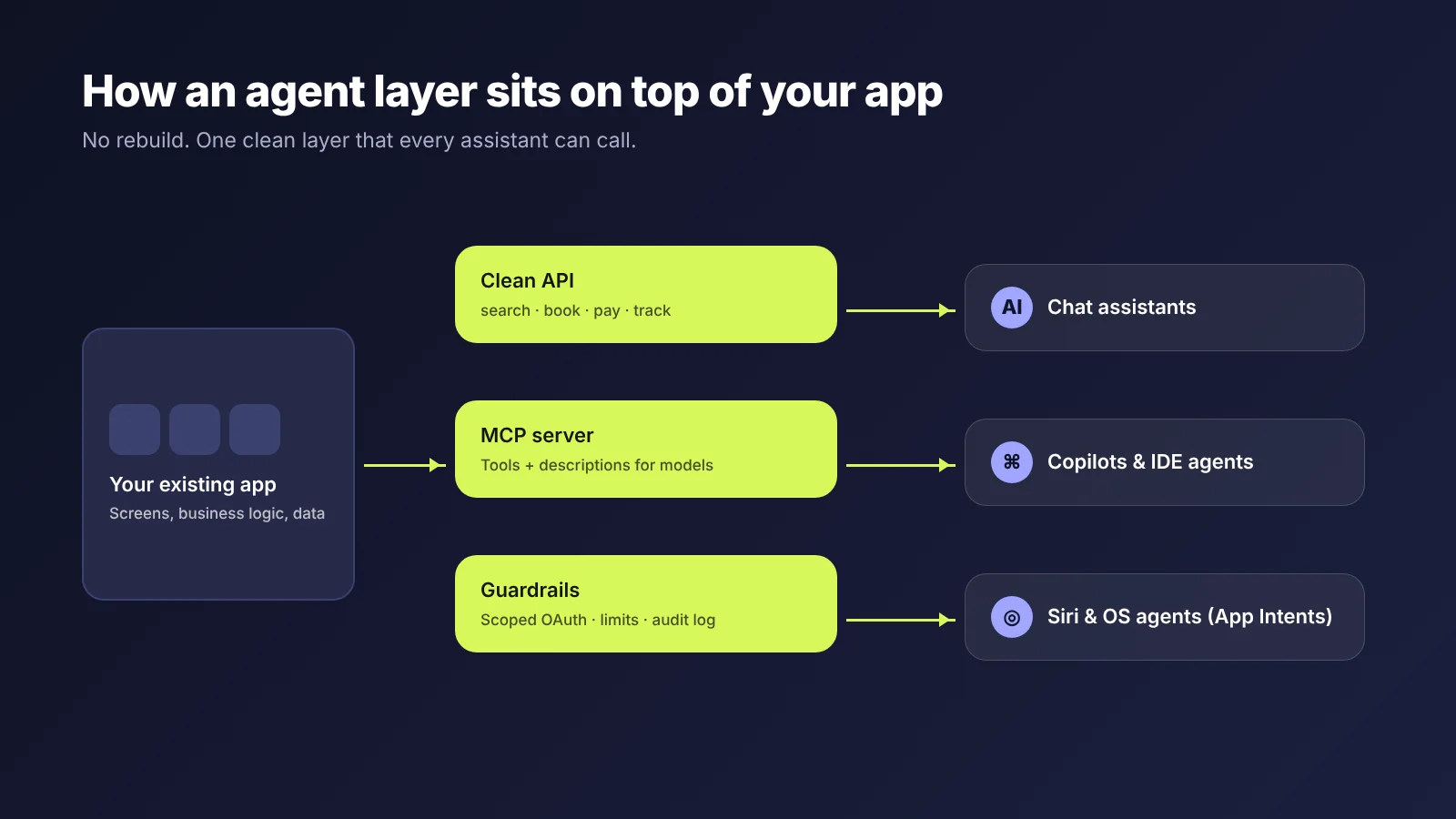
Pick 2–3 actions that make money. Not every feature needs an agent door. For a food delivery app, it is "search menu," "reorder" and "track order." Start there.
Extract them into clean APIs. If the logic lives in the mobile client, move it to the backend. This is the work most teams underestimate.
Wrap the APIs as an MCP server and OS intents. One MCP server serves ChatGPT, Claude, Gemini and Copilot. App Intents cover Siri and Apple Intelligence.
Add guardrails before launch. Scoped OAuth, confirmations for payments, limits and logs. An agent that can buy can also buy the wrong thing 500 times.
Which mistakes kill agent projects?
Exposing everything at once. 60 tools confuse a model. 5 clear tools get called correctly.
Vague tool descriptions. The model reads your descriptions to decide what to call. "Handles orders" fails; "Creates a new delivery order for a signed-in user; requires restaurant_id and items" works.
Skipping auth design. Sharing an admin API key with an agent is a breach waiting to happen. We wrote about why one breach can end a startup.
No owner. Agent traffic grows quietly. Without an owner, nobody notices when calls start failing.
How Olearis builds agent-ready products
We have shipped AI features across health, eCommerce, IoT and productivity apps, from RAG on private data to voice agents and agentic checkout. An agent-readiness project with us usually starts with a short audit: we score your product on the 10 checks above, map the 2–3 actions worth exposing and give you a plan with a fixed estimate.
Scored under 10? Send us your score. We will tell you, in one 30-minute call, which three changes would move you the furthest. Tell us about your project →
FAQ: Agent-ready apps
What is MCP in simple terms?
The Model Context Protocol is an open standard that lets AI assistants like ChatGPT and Claude connect to external apps. You describe your app’s actions once as "tools," and any MCP-compatible agent can use them.
Do I need an MCP server if I already have an API?
An API is the foundation, but agents need more: tool descriptions written for a model, scoped auth and safe defaults. An MCP server is a thin layer on top of your API that adds those.
Can a mobile-only app be agent-ready?
Yes. On iOS, App Intents let Siri and Apple Intelligence trigger actions inside your app. On Android, App Actions do the same for Gemini. For ChatGPT or Claude, you also need a backend API.
Is it safe to let AI agents act for my users?
It is safe when you design for it: OAuth with narrow scopes, user confirmation for payments or deletions, rate limits and a full audit log. It is unsafe when an agent gets the same access as an admin.
How long does it take to make an app agent-ready?
If clean APIs already exist, an MCP server for a few core actions is typically a matter of weeks. If business logic lives inside the mobile client, plan extra time to move it to the backend first.
Will agent traffic replace my app’s users?
No. It adds a new channel. Users still open apps for rich, visual tasks. Agents take over the quick, repeatable ones, and those are often the transactions that make money.