blog / What Does It Actually Cost to Build an AI App in 2026? (No Vague Answers)

Updated June 2026 — based on real project scoping, not a pricing-page guess.
Ask ten agencies what an AI app costs and you'll get ten versions of the same non-answer: "Well… it depends." It's the most honest dishonest sentence in our industry. Yes, it depends — but you came here for numbers, and refusing to give any is just a way to get you on a sales call before you know if you can afford the room.
So let's do the opposite. This is the honest breakdown of AI app development cost in 2026 — real ranges, what actually moves the price, and the hidden costs nobody puts in the quote. By the end you'll be able to sanity-check any proposal that lands on your desk, including ours.
Why "it depends" is technically true (but lazy)
Here's the thing the dodge gets right: an "AI app" can mean wildly different things. A chatbot bolted onto an existing product and a custom-trained recommendation engine with its own data pipeline are both "AI apps," and they're separated by a factor of ten in cost. So the price genuinely does depend — on what kind of AI, how much data, and how regulated your space is.
But "it depends" without ranges is useless to a founder trying to raise or budget. The market itself is enormous and growing — Grand View Research and Statista both peg the global AI software market in the hundreds of billions of dollars and climbing at double-digit annual growth. You are not building in a niche. You're building in the single most-funded category in tech, which is exactly why getting the cost conversation straight matters before you spend a cent.
The three honest ranges (2026 dollars, senior team)
Let's put real numbers down. These assume a senior team that won't need to rebuild everything in a year — the cheapest quote is almost never the cheapest project.
The lean AI MVP — one core AI feature, clean mobile or web app, one platform, basic backend. Think: an app with a genuinely useful AI assistant, smart search, or a recommendation feature. This is typically 3-5 months and a mid five-figure to low six-figure budget. It's enough to put a real product in front of real users and learn whether the AI actually changes their behaviour.
The full v1 — multiple AI features, mobile and web, real backend, integrations, admin dashboard, proper data handling. This is the version you scale on, and it's usually 6-9 months in the mid-to-high six figures. Most funded startups land here.
The enterprise platform — multi-tenant, custom model training, deep integrations, compliance per jurisdiction, the works. This crosses seven figures quickly, mostly because the integration and compliance work is its own project sitting on top of the app.
If someone quotes you a "full AI app" for the price of a lean MVP, that's not a deal — that's a warning. You're either getting a thin GPT wrapper or a rebuild invoice arriving in twelve months.
What actually moves the price (the real levers)
Forget hourly rates for a second. Here's what genuinely decides your cost to build an AI app:
The type of AI. Calling an existing model's API (OpenAI, Anthropic, Google) is dramatically cheaper than training or fine-tuning your own. Most products in 2026 should start with the former — and many never need the latter.
Your data. If your data is clean and structured, you're halfway home. If it's messy, scattered across systems, or doesn't exist yet, the data pipeline can cost more than the app.
How many platforms. iOS + Android + web is three products unless you build cross-platform. This is exactly why so many of our clients choose — one codebase instead of paying to build the same app twice.
Integrations. Each external system (payments, CRM, EHR, ERP) is its own mini-project. Three "simple integrations" can quietly double a timeline.
Regulation. Healthcare, finance, and legal carry compliance work — HIPAA, GDPR, SOC 2 — that a to-do app never touches. It's not optional, and it's not free.
Accuracy requirements. "Roughly right" is cheap. "Cannot be wrong" — medical, financial — means evaluation pipelines, human review, and testing that multiplies the budget.
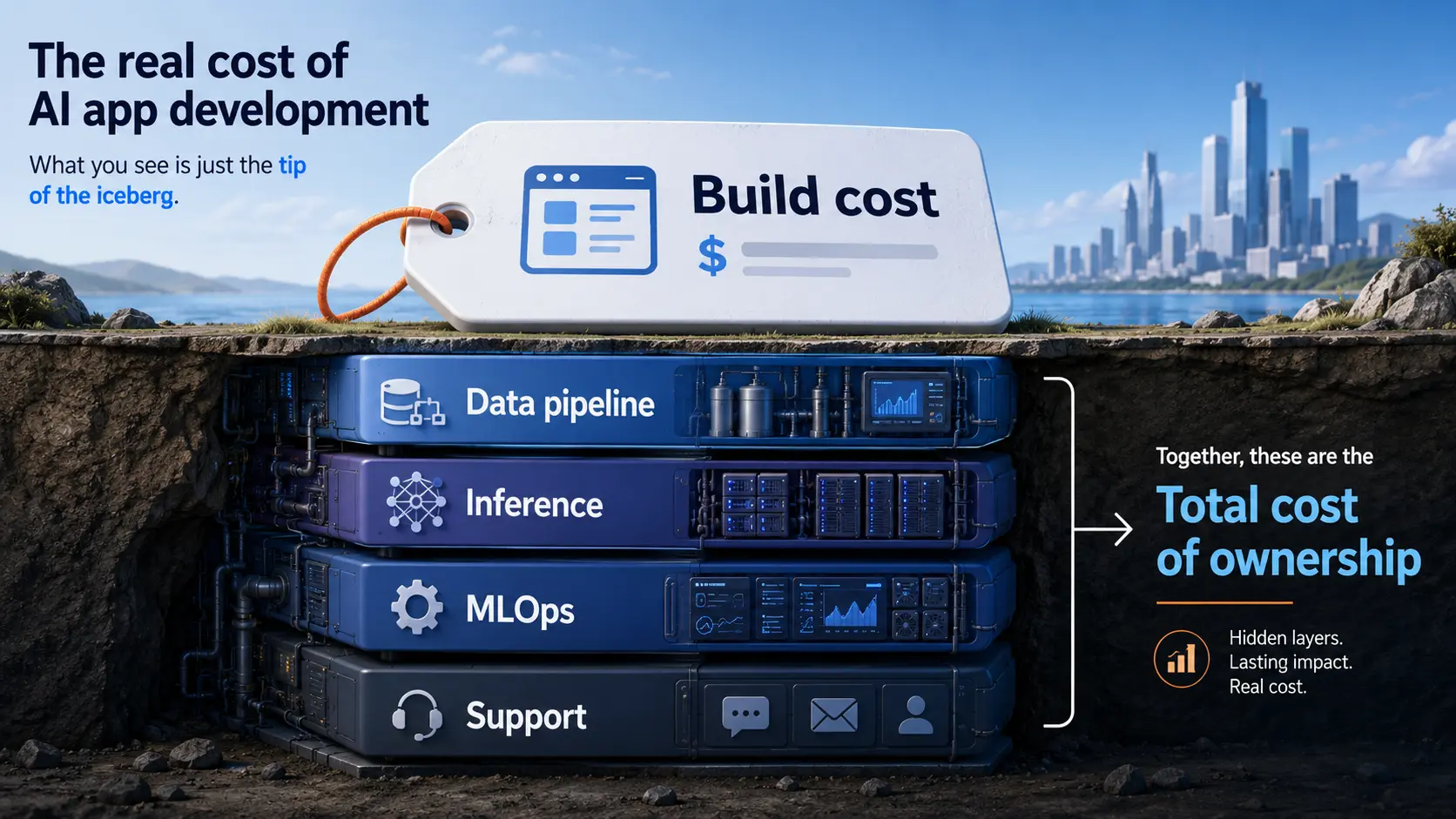
The hidden costs nobody puts in the quote
This is the part that turns a "cheap" build expensive, and the part most quotes conveniently skip:
Data pipeline & infrastructure — the unglamorous plumbing that feeds your AI. Real money, invisible on a demo.
MLOps & retraining — AI models drift. The world of 2026 isn't the world of 2028, and a model trained on old data quietly gets worse. Budget for ongoing retraining, not a one-time build.
Inference costs — every AI call costs money, forever. A popular app with a chatty AI feature can run a serious monthly bill. Andreessen Horowitz (a16z) has written extensively about how AI compute and inference costs reshape the unit economics of AI startups — your margin lives or dies here.
Moderation & safety — anything user-facing needs guardrails against bad outputs. Cheaper on day one than after a screenshot goes viral.
Post-launch support — the app isn't done at launch; that's when it starts. Bugs, updates, scaling, OS changes.
Gartner has repeatedly warned that a large share of AI projects never make it from prototype to production — and the number-one reason isn't the model, it's everything around it that the original budget ignored. The hidden costs are the project.
Build vs buy vs rescue — the cheapest path isn't always "build"
Before you commission anything, three honest options:
Buy off-the-shelf for anything that isn't your competitive advantage — auth, basic analytics, e-signature. Don't pay to reinvent commodities.
Build custom for the AI layer and the workflow that is your business — your differentiation, your data, your moat. This is where custom spend pays back.
Rescue what exists. If you've already got a no-code or AI-generated MVP, finishing it properly is often far cheaper than starting over — your validated idea and UX carry forward. (We wrote a whole honest guide on that "last 5%.") The point is that the right answer is decided by an audit, not a default, which is exactly how before quoting a number.
.webp?alt=media&token=5980a26d-127c-473c-a4a6-aeefadfa111f)
The number that actually matters: break-even, not build cost
Here's the reframe that changes the whole conversation. The build cost is a one-time number. The question that decides whether you should spend it is: how fast does the AI pay itself back?
A support-automation feature that deflects even a third of tickets, a recommendation engine that lifts conversion a few points, an AI workflow that saves each user an hour a week — plug real numbers in and a serious build often pays for itself inside a year. McKinsey has estimated that generative AI could add trillions of dollars in annual value across the economy, and the companies capturing it aren't the ones who spent the least — they're the ones who spent on the right thing and measured the payback.
A cheap AI MVP that nobody uses is infinitely expensive. A well-scoped one that moves a real metric is the best money a founder spends. That's the lens we bring to every estimate — through our , the question is never just "what does it cost" but "what does it return, and when."
Why founders get their AI estimates from Olearis
Honest version. We've shipped 400+ products, scaled apps past 10 million users, and built AI features in regulated industries where being wrong is expensive. That means when we give you a number, it's based on having actually built the thing before — not a markup on a guess. We'll tell you when a feature you love won't pay back, when an off-the-shelf tool beats a custom build, and when your existing MVP can be rescued instead of rebuilt. The honest estimate is cheaper for you than the optimistic one, every single time.
FAQ: AI app development cost
How much does it cost to build an AI app in 2026?
A lean AI MVP is typically mid five-figure to low six-figure. A full v1 with multiple AI features, mobile and web, is mid-to-high six figures. Enterprise platforms cross seven figures. The exact number depends on AI type, data, platforms, integrations, and regulation.
Why is one AI app so much cheaper than another?
Because "AI app" covers everything from a simple API call to a custom-trained model with its own data pipeline. Calling an existing model is far cheaper than training your own — and most products should start there.
What's the cheapest way to start?
A lean MVP with one genuinely useful AI feature, built cross-platform, calling an existing model rather than training one. Validate that users care before you spend on custom models or extra platforms.
What hidden costs should I budget for?
Data pipelines, MLOps and retraining, ongoing inference costs, moderation, and post-launch support. These are the costs that turn a "cheap" quote expensive, and they're often left out of the original number.
Can I build it in phases to spread the cost?
Yes, and you usually should. A well-architected MVP is designed so the full build sits on top of it without a rewrite — phasing spreads cost and lets real user behaviour guide what you fund next.
How do I know if the cost is worth it?
Calculate break-even, not just build cost. If the AI feature saves time, lifts conversion, or deflects support at a rate that recoups the build inside a year or so, it's worth it. If you can't name the metric it moves, don't build it yet.
Trying to budget an AI app and tired of "it depends"? Tell us what you're building and we'll give you an honest range, the hidden costs included, and a straight answer on build vs buy vs rescue — before you spend a cent