blog / AI Shopping Assistants: How to Build an eCommerce App That Sells While You Sleep

Published July 2026 — based on current AI eCommerce conversion data and agentic-commerce trends.
Quick answer: An AI shopping assistant is a conversational, personalized layer inside an eCommerce app that helps each shopper find, compare, and buy the right product — using natural language, visual search, and real-time recommendations. In 2026, AI-assisted shoppers convert roughly 4x better than those browsing a static store (about 12.3% versus 3.1%) and complete purchases up to 47% faster. Building one means combining a recommendation engine, visual search, conversational AI, and deep catalog integration into a single fast experience. This guide covers what it takes, what it costs, and where the ROI actually comes from.
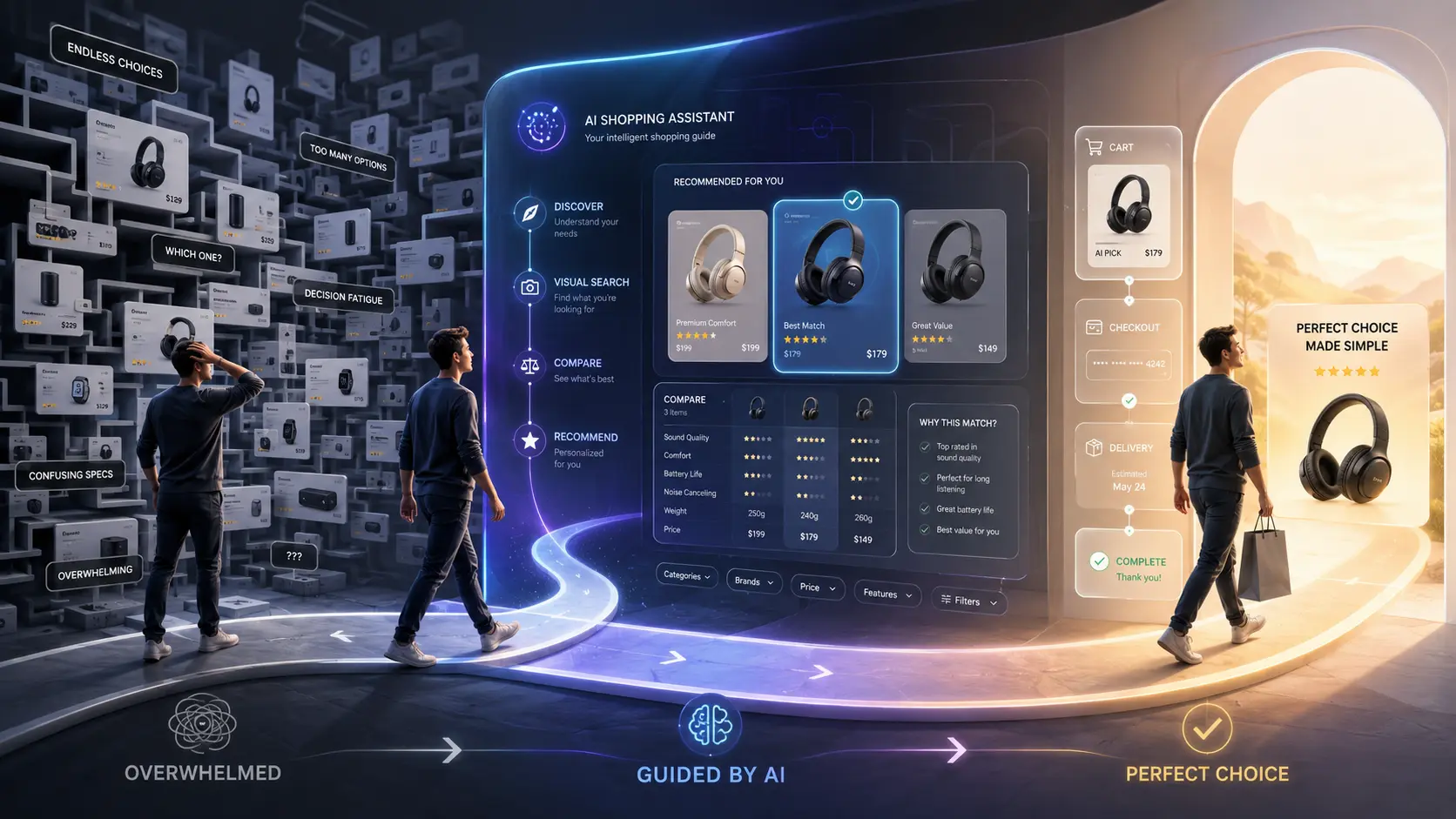
Online stores have a quiet problem: they are digital versions of a shelf. The shopper walks in, stares at thousands of products, and leaves. An AI shopping assistant turns that shelf into a salesperson — one that knows the catalog cold, remembers what each customer likes, and is awake at 3 a.m. That shift, from passive store to active assistant, is the biggest change in eCommerce since mobile checkout.
What Is an AI Shopping Assistant?
An AI shopping assistant is software inside an eCommerce app or website that guides shoppers the way a great in-store associate would — through conversation, visual understanding, and personalization.
It answers "which of these is best for a small kitchen?" in plain language. It lets a shopper photograph a jacket they saw on the street and find similar items instantly. It recommends the next product based on real behavior, not a generic "customers also bought" row. Underneath, it is a blend of conversational AI, a recommendation engine, and visual search wired directly into the product catalog and inventory. The global AI eCommerce market reflects the demand: it was valued around $7.25 billion in 2024 and is projected to reach $64–75 billion by 2034, a ~23.6% compound annual growth rate.
Do AI Shopping Assistants Actually Increase Sales?
Yes — the conversion data is among the strongest in retail technology.
AI chat and assistant experiences deliver roughly 4x higher conversion: about 12.3% of AI-engaged shoppers convert, versus 3.1% of those who never interact with AI. Assisted shoppers also complete purchases up to 47% faster, which cuts cart abandonment directly. On personalization specifically, McKinsey reports that getting it right most often drives a 5–15% revenue lift. These are not marginal gains — for a store doing real volume, a few conversion points is the difference between a business that works and one that does not. The engineering that produces those numbers is exactly what is built around.
The Core Features of an AI eCommerce App That Converts
Building an AI ecommerce app that performs comes down to a handful of features working together:
Conversational product discovery. A shopper describes what they want in their own words and the assistant narrows thousands of products to the right few — the single feature most responsible for the conversion lift.
Visual search. Shoppers upload or snap a photo and find matching products. Amazon alone handles around 4 billion shopping-related visual searches a month through Google Lens, AI visual search increases session duration by about 33%, and 62% of Gen Z shoppers prefer image-based search. For fashion and home especially, this is table stakes now.
Real personalization. Recommendations built on each user's behavior, not a static "bestsellers" row — the engine behind McKinsey's 5–15% revenue lift.
AR try-on and 3D product views. Letting shoppers see a sofa in their room or sunglasses on their face removes the last hesitation before buying. This is where turn browsers into buyers.
Smart cart and checkout. Bundle suggestions, one-tap reorder, and friction-free payment that closes the sale while intent is high.
Catalog and inventory integration. The assistant must know what is actually in stock, at what price, right now — the unglamorous backend work that makes everything above trustworthy.
What Is Agentic Commerce (and Why It Matters in 2026)?
Agentic commerce is the next step: AI that does not just assist the shopper but acts on their behalf — comparing options, tracking price drops, and completing purchases within set rules.
The technology has moved from assistant to decision-maker. AI now reasons across complex inputs, predicts behavior, and automates parts of the buying journey a human used to drive. Industry projections put agentic commerce — where AI acts as an active shopping partner — at more than $190 billion in eCommerce revenue by 2030. For a business, the lesson is direct: the store that presents cleanly to both human shoppers and their AI agents wins the next five years. Building for that dual audience is a design and engineering decision made best early, through .
How Much Does It Cost to Build an AI Shopping Assistant?
A focused AI shopping assistant added to an existing store runs a mid-five-figure to low-six-figure build. A full AI eCommerce app with visual search, AR, and deep personalization reaches the mid-to-high six figures.
The cost scales with the pieces: a conversational assistant over an existing catalog is the cheapest entry point; visual search, AR try-on, and a custom recommendation model add scope. The number that matters is the return, not the build. A 4x conversion lift and a 5–15% revenue increase pay back a serious build fast for any store with real traffic. The expensive mistake is a cheap bolt-on chatbot that frustrates shoppers and quietly costs sales — the trap is built to help clients avoid.
Why Retailers Bring AI eCommerce Projects to Olearis
has shipped 400+ products and scaled apps past 12 million users, including AR try-on experiences for global fashion brands and high-converting commerce apps. That means the recommendation engine, the visual search, the AR layer, and the catalog integration all get built by one team that has shipped each piece before — not stitched together by three vendors. Olearis states plainly which AI features will move a store's conversion rate and which are demo decoration, then builds the version that sells. An AI shopping assistant is only as good as the engineering behind it, and mediocre AI in a store loses more trust than no AI at all.

FAQ: AI Shopping Assistants & AI eCommerce Apps
What is an AI shopping assistant?
Software inside an eCommerce store that helps shoppers find and buy products through conversation, visual search, and personalization — like a knowledgeable in-store associate available 24/7. It combines conversational AI, a recommendation engine, and catalog integration.
How much do AI shopping assistants increase conversion?
AI-engaged shoppers convert roughly 4x better than non-engaged ones (about 12.3% versus 3.1%) and buy up to 47% faster. Strong personalization adds a 5–15% revenue lift on top, per McKinsey.
How much does it cost to build an AI eCommerce app?
A focused AI shopping assistant on an existing store is a mid-five-figure to low-six-figure build. A full AI eCommerce app with visual search, AR try-on, and deep personalization reaches the mid-to-high six figures.
What is visual search in eCommerce?
Visual search lets shoppers find products by photo instead of text. It increases session duration by about 33%, and 62% of Gen Z shoppers prefer it — essential for fashion, home, and design-led catalogs.
What is agentic commerce?
Agentic commerce is AI that acts on a shopper's behalf — comparing, tracking, and buying within set rules — rather than just assisting. It is projected to drive over $190 billion in eCommerce revenue by 2030, which makes presenting cleanly to AI agents a real strategic advantage.
Can an AI shopping assistant integrate with Shopify or my existing store?
Yes. An assistant can layer onto Shopify, custom stores, and most major platforms through their APIs. The critical work is real-time catalog and inventory integration so the AI recommends only what is genuinely available.
Want an AI shopping assistant that actually lifts conversion, not a chatbot that annoys shoppers? Tell about your store and catalog, and get an honest read on which AI features will move your numbers — and what it takes to build them.