1M+

downloads · 500K+ accounts created since 2021

4.7 ★

App Store rating

185K+

active users in an independent 5-year real-world evaluation

−23%

depression symptoms (PHQ-9), −16% anxiety (GAD-7)

2019 → today

continuous product partnership

About UpLife

UpLife grew from a CBT-based self-help app into a stepped-care platform used by 500K+ people, therapists and clinics

UpLife covers every step of the mental health care continuum, from self-guided support to therapist-led blended care. Its programs are built on a CBT backbone and combine it with mindfulness, positive psychology and other evidence-informed methods, all designed with clinical psychologists.

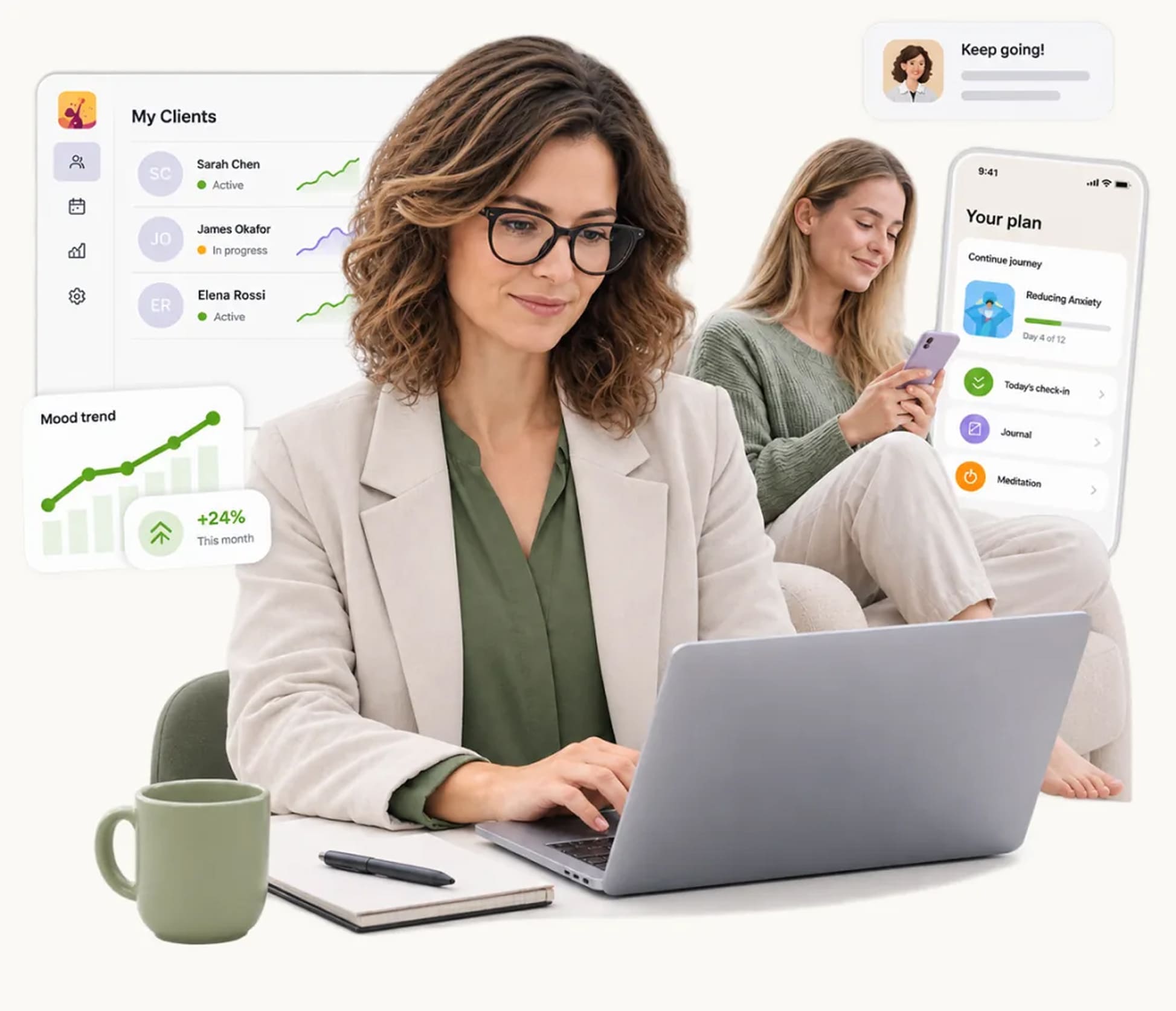
A daily 15-minute session mixes audio or written journeys, interactive exercises, mood check-ins, journaling and meditation; the HIPAA-compliant portal lets clinicians assign content, run PHQ-9, GAD-7 and WHO-5 assessments and track progress between sessions.

Therapists and group practices

Blended care: assign journeys, review scores in under 2 minutes a week.

Clinics and university health centers

Stepped care for waitlists and between-visit support.

Corporate wellness programs

Structured, measurable support for employees.

Individuals

Self-guided journeys on iOS and Android, also via Setapp.

UpLife Inc. was founded in 2019 by Olearis founder Oleg Lavrentyev and product leader Alexander Makhtin, together with clinical psychologist Nataliia Kuzmina.

The company is based in Newark, DE and Kyiv, with Jeff Musa as CEO and an advisory board from clinical psychology and digital health.

Olearis has owned product, design, engineering and analytics from day one, so this case shows how we build and grow a health product end to end.

The challenge

Turning therapy into a product people return to every day, then into a tool clinicians trust

Building a mental-health app was never mainly an engineering problem. The hard part was translating a clinical method into an experience people understand, trust and come back to, making it work as a business in one of the most crowded App Store categories, and later proving it to a professional buyer who asks about evidence, HIPAA and workflow before anything else.

01

Clinical credibility

Content had to be evidence-informed and psychologist-authored, yet simple enough for a 15-minute session on a phone. Bare "CBT" claims were off the table.

02

Engagement and retention

Most wellbeing apps lose users within days. UpLife had to build a daily ritual, not just deliver content, and prove it with data.

03

Unit economics

Paid acquisition in the US mental-health market is expensive, so onboarding, paywall and conversion had to be engineered as carefully as the product.

04

Lean team, two platforms

iOS and Android had to be built and supported by a very small team without losing native quality.

05

Ad-platform constraints

Ad networks moderate health messaging heavily, so positioning and in-app screens had to change fast, without waiting for store releases.

06

From consumer app to clinical workflow

The same platform had to grow into a therapist portal with HIPAA compliance, a BAA and clinical assessments, without rebuilding the consumer product.

Strategic approach

Five priorities that shaped every decision

Validate before you build

Market research, work with psychologists and in-depth user interviews came before the first line of code. A fully designed UX and well-described use cases kept rework low.

Behavior change, not information

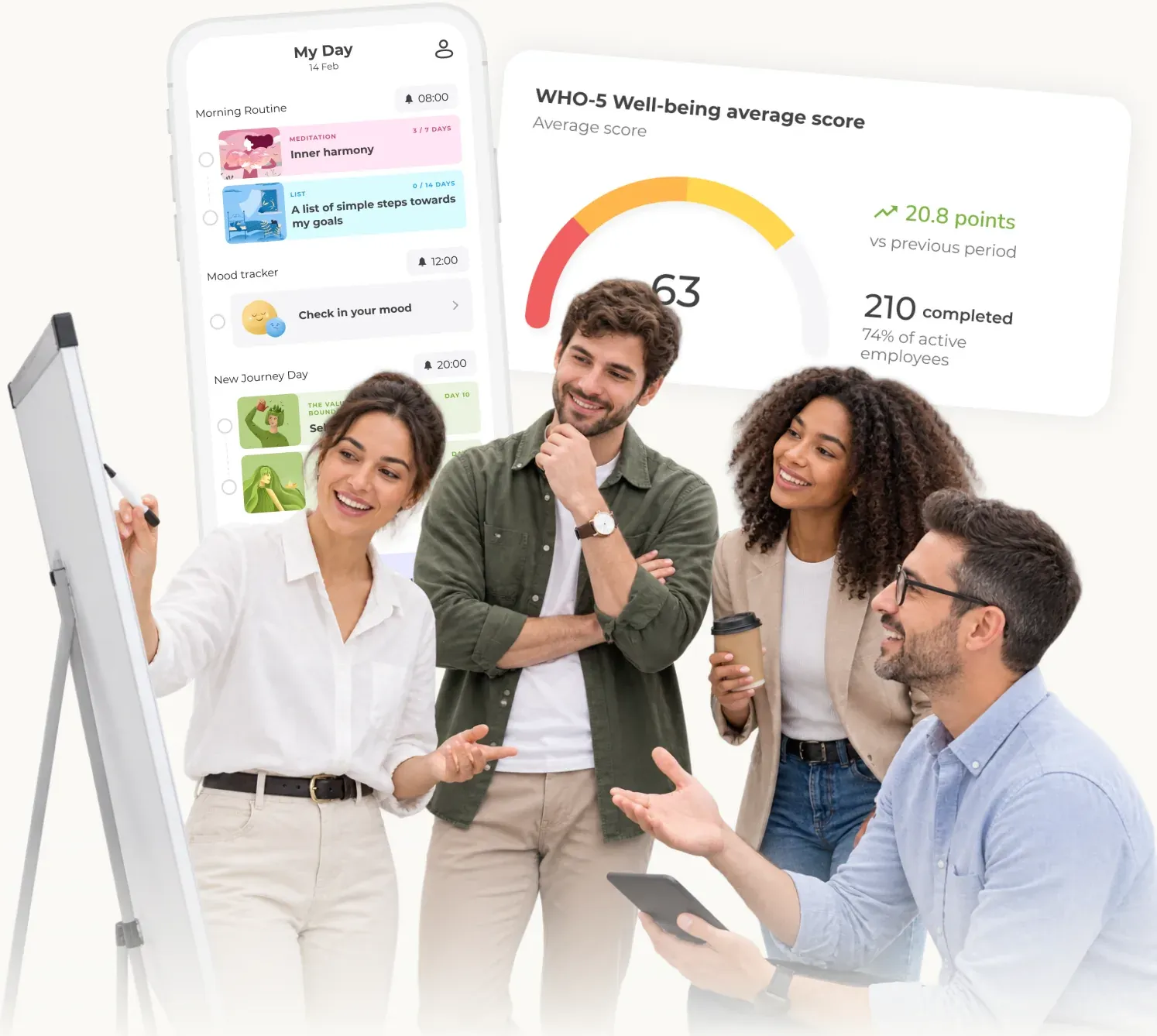
Every feature exists to build a daily ritual: journeys with integrated exercises, a chronological Daily Plan with reminders, one-minute mood check-ins and a journal that shows people their own patterns.

Data over opinions

Analytics and attribution were built in from the start, so roadmap decisions rested on behavioral and revenue data, and later on PHQ-9, GAD-7 and WHO-5 outcome measures collected in the product.

AI that recommends, never diagnoses

Ask Lila, the in-app assistant, recommends existing psychologist-created content based on what the user shares; it does not generate therapy. The mood tracker uses AI to surface mind traps and trends. Clinicians stay central to care.

Lean architecture that evolves

One cross-platform codebase, a serverless backend and remotely configured screens kept the team small and infrastructure cheap, and left room to add a secure clinician portal years later.
UpLife in use

What was done

From discovery to a care platform in five phases

Phase 1

2019 – 2020

Discovery and MVP

  • Company founded by Oleg Lavrentyev, Alexander Makhtin and psychologist Nataliia Kuzmina
  • First 12 CBT-based journeys written with psychologists
  • Flutter app for iOS and Android from one codebase, Firebase serverless backend
  • Market research, positioning, user interviews and journey mapping
  • Full UX and UI before development
  • GitLab CI/CD, beta test with a limited audience
MVP in 9 months with 1 senior developer + 1 QA

Phase 2

2021 – 2023

Public launch and growth engine

  • Public release in June 2021; early growth from word of mouth and App Store optimization
  • Onboarding, paywall and conversion optimization; web-to-app onboarding funnel with Stripe checkout
  • Paid acquisition on Google and Meta from 2023, segmented by audience and condition
  • Amplitude, RevenueCat and AppsFlyer for analytics and attribution
  • Remote-config screens to adapt to ad-platform rules without releases
  • Ukrainian localization and free access for users in Ukraine (Humanitarian Gift Program)
Positive ROAS by February 2023

Phase 3

2024

Scale to $1M ARR

  • Publishing partnership with Kovalee from January 2024, which took the product to $1M ARR
  • Ask Lila AI assistant for content recommendations
  • In-product PHQ-9, GAD-7 and WHO-5 assessments tied to personal plans
  • Library grown to 50+ psychologist-developed programs across clinical and wellness topics
  • Smart mood tracker: emotions, factors, reflections, AI recognition of mind traps
  • Iterations driven by retention and conversion data
$1M ARR in 2024

Phase 4

2025

From consumer app to care platform

  • Feb 2025: secure client and patient portal
  • Oct 2025: first therapist pilots on the platform
  • Nov 2025: UpLife for Therapists launched, blended-care model
  • Feb 2025: $100K Google for Startups grant; Jun 2025: 1991 Accelerator cohort
  • Autumn 2025: HIPAA compliance, BAA available; trust center at trust.uplife.app
  • Dec 2025: TRMNL4 accelerator by Meta and Genesis; B2B outreach begins
Blended care launched, backed by Google for Startups

Phase 5

2026 – today

Stepped-care positioning and real-world evidence

  • Repositioned as a stepped-care platform for four audiences: therapists, clinics and university health centers, corporate wellness, individuals
  • Independent observational evaluation by Red Digital on five years of real-world data
  • No FDA clearance required (FDA Health Policy Navigator, Jan 2026)
  • New marketing site, pricing and get-started flows for each audience
  • Treatment protocols for anxiety, depression, ADHD, trauma, relationships and sleep
  • Marketing refocused on group practices and health systems
Population-level stepped care, clinically validated

Visual proof

Outcomes you can measure

Symptom scores, baseline → follow-up

Estimated marginal means from the 2021–2026 real-world evaluation (linear mixed models)

181260
−23%
16.0
Baseline
12.4
Follow-up
PHQ-9 · depression
−16%
12.6
Baseline
10.6
Follow-up
GAD-7 · anxiety

Independent observational pre-post evaluation by Red Digital, real-world data June 2021 – April 2026, no control group. 185,050 active users in the engagement analysis; outcome subset PHQ-9 baseline N=868, GAD-7 baseline N=1,305. Each additional fully completed journey was associated with ~0.3–0.4 lower PHQ-9 points (dose-response).

The decision loop

How data reached the roadmap, and later the clinician

Product

UpLife app→Web onboarding→Paywall→Daily Plan

Measurement

AmplitudeRevenueCatAppsFlyerPHQ-9 · GAD-7 · WHO-5

Change without a release

Remote Config→screens, copy, offers

Stepped care

Self-guided app→Therapist portal→Assign · assess · review

Results

A product validated by the market and by clinical data

4,7 in App Store1M+ downloads

UpLife built a profitable consumer growth engine with 1M+ downloads, and then used the same foundation to enter clinical care with therapists, clinics and workplace programs, backed by five years of real-world outcome data.

Time to MVP

9 months

with 1 senior developer + 1 QA

Engagement

185K+

users went beyond sign-up and used the app; two thirds followed their first journey for 4–16 days

Unit economics

Positive

ROAS by February 2023, before the Kovalee partnership

Clinical evidence

−23% PHQ-9 · −16% GAD-7

statistically significant reductions in depression and anxiety symptoms, with a dose-response effect, in an independent 5-year real-world evaluation of 185K+ active users (Red Digital, 2021–2026)

Compliance

HIPAA · BAA

trust center at trust.uplife.app; no FDA clearance required

Recognition

Google for Startups

$100K grant · Startup World Cup finalist · 1991 Accelerator · TRMNL4 by Meta and Genesis

01

Repeatable growth engine

Analytics, attribution and experiments built into the product; positive ROAS before scaling spend.

02

Lean operations

A serverless backend and one codebase that a very small team can run.

03

Speed of change

Onboarding, paywalls and messaging updated without new releases.

04

Ready for healthcare

The same platform now serves clinicians, clinics and workplace programs under HIPAA.

Why it worked

Product expertise, clinical content and engineering were never separated

One product organization

Olearis didn't act as an outsourced team executing tickets. Strategy, clinical content, UX, engineering and analytics worked together, so the team kept testing assumptions and adjusting the roadmap instead of delivering a fixed scope.

We've been on the founder's side of the table

We've paid for user acquisition, fought for retention, worked with a publisher, raised grants and taken a product through HIPAA. We bring the same judgment about what is worth building to every client product.

Measurement from day one

Decisions from paywall design to new features rested on behavioral and revenue data, and later on clinical outcome measures that an independent evaluation could analyze.

Architecture chosen for the business

Flutter and a serverless backend were the fastest, leanest way to ship two platforms with a tiny team, and flexible enough to add a HIPAA-compliant clinician portal years later without a rewrite.

What's next

A product relationship that continued well beyond launch

The work didn't end with the first release, or with the first million downloads. Olearis keeps developing UpLife as it grows into a stepped-care platform for professional care.

01

Self-serve therapist trial and blended-care workflows at scale

02

Pilots with group practices, clinics, university health centers and employers

03

AI intelligence layer: treatment planning, clinical monitoring and risk signals, continuous learning from outcomes

04

Deeper clinical outcome measurement and published evidence

05

A growing library across clinical conditions and wellness topics

Building or scaling
a digital health product?

We help digital-health teams turn clinical and behavioral concepts into products people use, from discovery and UX to engineering, analytics, HIPAA compliance and growth.

Technology foundation

FlutterFirebase (serverless)GitLab CI/CDAmplitudeRevenueCatAppsFlyerRemote ConfigStripe web checkoutAsk Lila AI assistantClinician portalHIPAA-compliant infrastructure