blog / AI Recruitment App Development: Hire Smarter in 2026

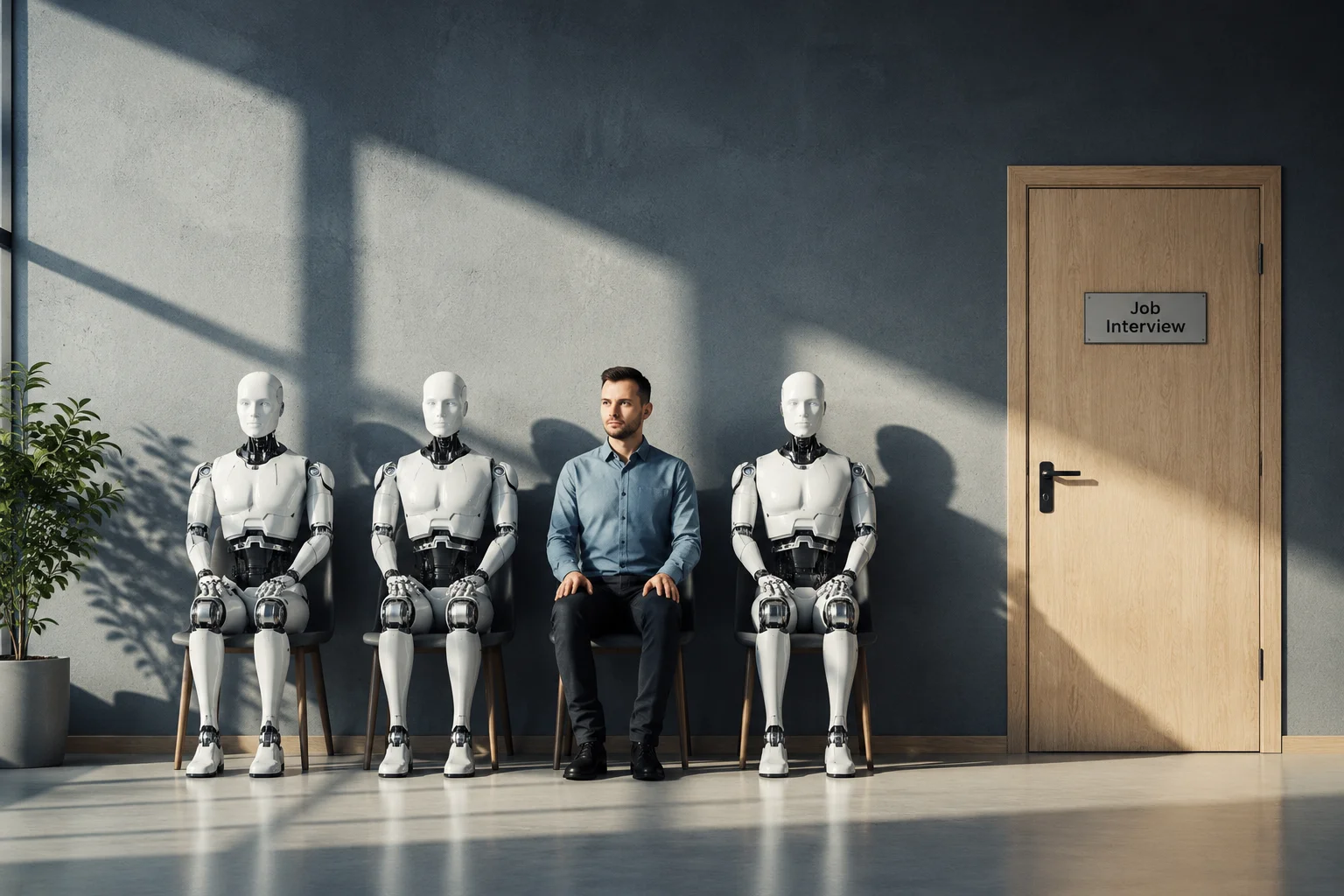
AI Recruitment App Development: Why Your Hiring Funnel Quietly Started Hiring AI Bots
Updated May 2026 — reflects the EU AI Act high-risk classification and the latest US EEOC guidance on automated hiring tools.
Look, hiring is broken. Not "needs improvement" broken. Properly broken. You post a job, 437 applications come in by Friday, your ATS quietly throws away 80% of them based on rules nobody in your company remembers writing, your recruiter spends three weeks on a shortlist of five, and two of those five are AI-generated polished versions of much weaker candidates. The one person you actually wanted to hire? Their resume was rejected at minute one because they had a six-month gap caring for a sick parent.
This is what AI recruitment app development should be solving in 2026 — not "automating screening", not "using GPT to write job posts faster". Fixing the part of hiring that is currently making everyone miserable at the same time.
So why did hiring quietly break this hard?
Three things happened at once and nobody noticed until everyone was tired.
Generative AI got really good at writing resumes — suspiciously good. Recruiters in 2026 are reading ten polished versions of the same career story per role and cannot tell who actually wrote any of it. So they fall back on the only signals left — brand of school, brand of company, exact keyword matches — which is exactly the bias they spent five years trying to remove.
Meanwhile, candidates are sending ten times more applications because their own AI agent does it for them. You did not really receive 437 applications. You received maybe 60 people, each fired off by a script that scraped LinkedIn at 3 a.m. The "more applicants" your dashboard is bragging about is actually less signal.
And then regulators woke up. The EU AI Act now classifies most automated hiring tools as high-risk — audits, documentation, transparency, the whole thing. The US EEOC has been pursuing companies whose ATS quietly rejected protected groups. NYC already requires bias audits on automated hiring tools. You cannot hide behind "the AI did it" anymore.
That is the world your new product is being born into. Building a normal "AI for HR" tool right now is like opening a fish restaurant in a flooded basement. You need a different product.
What "AI recruitment" actually means inside a product that works
Skip the demo-day pitch. Inside a hiring app that earns its keep in 2026, AI is doing four jobs at once — and "filter resumes faster" is not one of them.
It is reading signal under the polish. A modern AI screener does not match keywords. It looks at how a candidate writes about their work, what they describe instead of what they claim, which projects they keep coming back to. The patterns of a human telling their own story do not match the patterns of GPT writing a resume for them — and that gap is your only defence against AI-on-AI resume warfare.
It is scoring fit, not pedigree. A model trained on actual outcomes — who stayed, got promoted, left in six months — reliably surfaces people the ATS would have thrown away. The hidden 80% your competitors are ignoring is your biggest source of cheap, motivated talent.
It is running structured interviews so humans do not have to wing it. Calibrated questions per role, automatic note-taking, comparable scoring — every candidate gets the same fair shot, every hiring manager makes a real comparison instead of going on vibes after lunch.
And — the underrated one — it is honestly closing the loop with candidates. Personalised rejection notes. Feedback they can use. A status update that means something. Your competitors will never bother to build this, and it is the thing that turns a job applicant into a fan even when they did not get hired. Quiet retention superpower.
The features that move time-to-hire (and the ones that just demo well)
Most pitch decks promise twenty features. Six matter.
A smart intake flow that asks the hiring manager what success actually looks like, not what a "good resume" looks like. AI-assisted job descriptions that read like a human wrote them (every other JD on the market now reads like ChatGPT in a hurry, and candidates can tell). A screening model trained on your outcomes, not generic resume data. Structured interviews that work on mobile — every senior candidate interviews from their phone between meetings, exactly the polished mobile experience our ships for clients. A candidate communications layer that is not a no-reply email. And a bias-and-audit dashboard from day one, because the moment a regulator or journalist asks and you do not have one, your product dies in a week.
Stuff that wins demos but does not matter: a single magic compatibility percentage, deepfake video interviews on the AI's side, "personality matching" from five-minute games. Cool slides, bad product.
"But isn't AI hiring kind of, you know, illegal now?"
Half the founders building HR tech right now believe AI in hiring has been quietly banned. It has not — but the rules got serious enough that ignoring them is malpractice.
Under the EU AI Act, hiring tools that evaluate or rank candidates are high-risk systems: you owe a risk-management process, documentation, transparency to the candidate, and a human override path. The US EEOC has actively pursued companies whose AI rejected protected groups at suspicious rates. NYC Local Law 144 requires annual bias audits and public disclosure. Illinois, Colorado and California all have their own versions.
Good news: building compliantly from day one is cheaper than the cleanup. Bias auditing, candidate notifications, human overrides, model cards — these are weeks of engineering work. The companies eating this market in 2026 ship compliant by default and advertise it as a feature. The cautionary tales are the ones moving fast and breaking laws.
The Amazon ghost that haunts every AI hiring project
Quick history, because you will be asked about this in every sales call. In 2018 Amazon publicly killed an internal AI recruiting tool that had taught itself to penalise resumes containing the word "women's" (as in "women's chess club captain"). It had learned from a decade of mostly-male hires and quietly concluded women were a bad bet.
Every AI recruitment project since then has been arguing with Amazon's ghost. Honest answer: yes, this can happen again, it will happen again, and the only protection is to build like you expect to be audited next Tuesday. Train on outcomes that actually matter — performance, retention, promotion — not on who got hired in the first place, because the first hire is the bias. Measure disparate impact continuously in a dashboard your CEO can see. Keep a human override on every decision, with a written reason the candidate is allowed to read.
This is where Olearis tends to do well — leans hard on compliance-aware engineering. Healthcare, fintech, IoT — ten years of building products where the regulator visits before the user does.
How much does AI recruitment app development actually cost?
The honest 2026 ranges with a senior team:
A focused MVP — intake, AI screening, structured interview tool, candidate communications, basic bias dashboard, one platform — is 4–5 months at a mid-five-figure to low-six-figure budget. A full v1 with mobile apps for recruiters and candidates, AI-assisted job descriptions, ATS/HRIS integrations, scheduling and a proper audit layer is 6–9 months in the mid-to-high six figures. Enterprise platforms for Fortune 500 — multi-tenant, jurisdiction-by-jurisdiction compliance, deep ATS integrations — cross into seven figures.
The interesting number is not the build cost — it is the break-even. A mid-sized team hires ~100 people a year. Industry research puts all-in cost-per-hire in the four-to-five-thousand-dollar range, much higher for senior roles. If your app shaves 15% off time-to-hire and prevents one bad hire a year, the entire build pays back inside twelve months. That math is why HR tech keeps attracting capital even when other SaaS verticals cool.
The thing every founder gets wrong about candidate experience
You will obsess over the recruiter UI. Normal — recruiters are who you sell to. But the screen your product lives or dies on is the candidate screen.
A candidate's experience of your product is a single page on their phone, on the train, between meetings. If that page is slow, vague or condescending, they tell every friend in their network — and in 2026 those friends are reading Glassdoor and r/recruitinghell before they apply anywhere. Your candidate UX is your employer brand. Mobile-first is not a feature here, it is the whole product. Same reason we build cross-platform with on most app projects — the moment a candidate sees a janky mobile screen, you have lost them.
The move nobody else is making: tell candidates honestly where they are. Not "thank you for your application, we will be in touch." Actually tell them — 47 people applied, you are in the top 12, here is what we are looking for next round. Candidates love it. Recruiters were terrified at first and now love it because their inbox stops filling up with "any update?" emails. Build it.
Why founders bring AI recruitment projects to Olearis
Honest version. Hiring products fail in three predictable ways — regulators, bias scandals, candidate burnout — and we have built in regulated industries (fintech, healthcare, IoT) long enough to spot those failure modes before they ship. Senior by default: the architect scoping your screening model is the one shipping it. Design, mobile, backend, AI/ML and QA live under one roof, so your AI service, mobile candidate app, integrations and audit dashboard are not being hot-potatoed between three vendors with conflicting Jira boards.
And we do something most agencies do not — we tell founders when a feature they love will not move their hiring KPI. About to build a "personality-fit" scoring engine? We will push back, because regulators are coming for that one first and the science behind it is shaky. Hiring is too high-stakes to ship features for the demo. Exactly the kind of work where you want a partner who .
FAQ: AI recruitment app development
How much does AI recruitment app development cost in 2026?
A focused MVP is mid-five-figure to low-six-figure. A full v1 with dual mobile apps, ATS integrations and a proper audit layer is mid-to-high six figures. Enterprise platforms cross into seven figures.
How long until we can soft-launch?
4–5 months for a senior-team MVP. 6–9 months for a feature-complete v1. Anything shorter is a template around a generic GPT screener — recruiters spot it in week one.
Is AI recruitment legal in 2026?
Yes, but regulated. EU AI Act treats hiring tools as high-risk. US EEOC actively pursues bias cases. NYC, Illinois, Colorado and California have automated-hiring disclosure laws. Build compliant from day one — retrofitting is far more expensive.
How do we avoid the Amazon problem with biased AI?
Train on outcomes (performance, retention, promotion), not on who you hired before. Monitor disparate impact continuously in a dashboard leadership checks. Keep a human override with written reason on every decision. External bias audit before launch and annually after.
Can the app integrate with our existing ATS and HRIS?
Yes — Greenhouse, Lever, Workable, Workday, BambooHR, SAP SuccessFactors all have APIs. The hard part is normalising data from systems that disagree about "what is a candidate stage".
iOS, Android, or cross-platform?
Flutter for most consumer-facing recruitment apps (candidates are on mobile, one code base ships fast). Native when the product leans on advanced video, document scanning or enterprise security.
What's the smartest way to measure if our AI is actually working?
Track time-to-hire, quality-of-hire, candidate NPS, and disparate impact ratios. All four moving the right way = AI works. Only time-to-hire moving = you are speeding up bad hiring.
Should we build or buy?
Buy off-the-shelf for validation. Build custom the moment recruitment becomes your competitive advantage. Companies that lose the next five years are the ones treating hiring as ops instead of product.
Thinking about an AI recruitment app, an internal hiring tool, or a full HR-tech platform that won't end up in a journalist's "bias scandal" article? Talk to us. We will tell you where the regulators are looking, where the candidates are quietly hating your competitors, and where the AI actually pays back.